
Cycling has always had a problem with itself. For decades, the sport carried an air of unspoken hierarchy the right kit, the right club, the right attitude — and if you showed up without ticking every box, you felt it. You felt the glances. The distance was palpable. In a word — you did not belong.
Sam Williams felt it too. And rather than accepting it, he built a brand around it.
Paria — pronounced PA-RYE-AH — literally means social outcast. That is not an accident. That is a declaration of intent. Founded in Leeds, Yorkshire, by a straight-talking Mancunian who fell deeper in love with riding than he ever did with cycling’s culture — Paria cycling grew from one man’s frustration. Today it stands among the most distinctive cycling apparel brands in the UK. If you have not discovered it yet, consider this your introduction — because what Paria is doing matters far beyond the world of two wheels.
Born from Frustration, Built on Conviction
To understand Paria, you first need to understand where it came from. Sam had been cycling in one form or another for most of his life — from BMX in the 80s, to mountain biking when it first hit the UK in the 90s, then road cycling and a little track in the noughties. As his riding developed, his search for kit that actually reflected who he was grew increasingly fruitless.
He ended up buying bland, unbranded kit just to stay away from the walking, full-kit branded billboard apparel that seemed so prevalent. What bothered him even more, though, was the culture sitting underneath the clothing. Cycling carried an inherent elitism — unwritten rules covering everything from how you should wear your shades on your head to what kit your riding style demanded.
For someone who had always bucked convention, this was genuinely infuriating. Consequently, Sam did what any self-respecting outsider eventually does: he stopped waiting for the thing he wanted to exist, and he built it himself. The name adapts “pariah,” reflecting the feeling of never quite fitting in on a bike. From that honest, personal starting point, everything else followed.
The Aesthetic That Changes Everything
Here is where Paria truly separates itself from the crowded cycling apparel market. Most brands follow a predictable playbook — sponsor a pro team, repeat last season’s colourways, and call it innovation. Paria does none of that.
The brand grew from an appreciation of the irreverent, the independent, and the alternative, twinned with a love of cycling and a keen eye for great design — merging cyclewear with street style in a similar way to skateboarding wear. Sam wanted to bring the cultural energy of labels like Stussy, Carhartt WIP, and Patagonia into a space that had never encountered anything quite like it. The resulting aesthetic produces apparel that looks extraordinary on the road and equally compelling off it.
Rather than leaning on in-house designers working to a tired formula, Paria collaborates with artists, designers, and illustrators to create something inspiring that promotes a friendly and inclusive attitude to cycling. Crucially, they do not play it safe with cut-and-paste graphics or done-to-death colourways.
This commitment to genuine creative collaboration goes far beyond a marketing line. In 2025, a chance conversation in the Paria shop led to a link-up with local street artist Misc Etc, based just down the road from their Leeds HQ. The result: a limited-edition cycling jersey, a shop mural, a beer can, and a full community event. That kind of integrated creative approach — where apparel, art, and community all intersect in one cohesive moment — is extraordinarily rare in cycling. It is exactly the kind of move that keeps Paria feeling vital and culturally alive.
Performance Without Compromise
It would be easy to assume that a brand so focused on aesthetics might treat performance as secondary. That assumption would be wrong. Paria builds its reputation on the idea that looking bold and riding hard are not in conflict — they are, in fact, perfectly complementary.
Paria set out to create something new for cyclists that couples urban influences with the grit and fervour of the Yorkshire countryside. The goal: apparel that delivers exceptional performance and looks great, without ever compromising on technical ability or durability. Too many brands in the lifestyle-cycling crossover sacrifice function for form. Paria refuses to make that trade-off.
Yorkshire is, by any measure, one of the most demanding testing grounds for cycling kit in Britain. Since the 2014 Tour de France Grand Depart launched from Leeds and swept through the Dales, the region has worn its cycling identity with enormous pride. When Paria builds kit for those roads — the brutal climbs, the sideways rain, the relentless wind — the performance credibility comes built into the geography itself.
The product range reflects this thoroughly. The full lineup spans short and long sleeve jerseys, gilets, jackets, bib shorts, bib tights, gravel cargo bibs, sherpa fleeces, base layers, socks, accessories, and a growing running kit range. Prices start at £12 for accessories and reach up to £95 for outerwear — making Paria genuinely accessible without feeling cheap. Product development and design happens in-house in Leeds, with manufacture predominantly in Europe and the UK — a meaningful commitment to quality control and transparency in an era of opaque supply chains.
A Community, Not Just a Customer Base
One of the most significant things about Paria — arguably what elevates it above the status of simply a very good clothing brand — is the community it has built and continues to nurture. This did not happen by accident. From the very beginning, Sam understood that cycling’s problem was cultural just as much as it was aesthetic.
The Paria ethos has always centred on collaboration and inclusion. The brand grew out of a perceived air of exclusivity in the world of cycling clubs and teams, one that permeated into all corners of velo-based culture — including apparel. Rather than simply critiquing that exclusivity, Paria set out to dismantle it — building what the brand itself describes as a club for people who did not feel they belonged in a club.
That spirit manifests in real, tangible ways. Paria sponsors several cycling teams, including Huddersfield’s Paria Magic Rock Racing and youth team Tofauti Everyone Active, and offers a custom kit design service for clubs and teams of all sizes. The brand works directly with grassroots cycling communities across the UK, helping collectives find their visual identity.
As Outlands founder Dan put it, the custom cycling jersey became the single biggest asset in building their club. Without it, they would never have gained visibility — or had a brand to build on.
Beyond kit, Paria also runs its own annual cycling event — the Paperboy — now entering its tenth year. The event rolls out of Leeds and into the Yorkshire countryside, designed for riders who want more than just a sportive, with great routes, standout kit, quality coffee, and a post-ride celebration. It is the kind of event that perfectly encapsulates what Paria stands for: challenging, social, inclusive, and unapologetically fun.
The Paria Cafe: Where Cycling Culture Gets a Physical Home
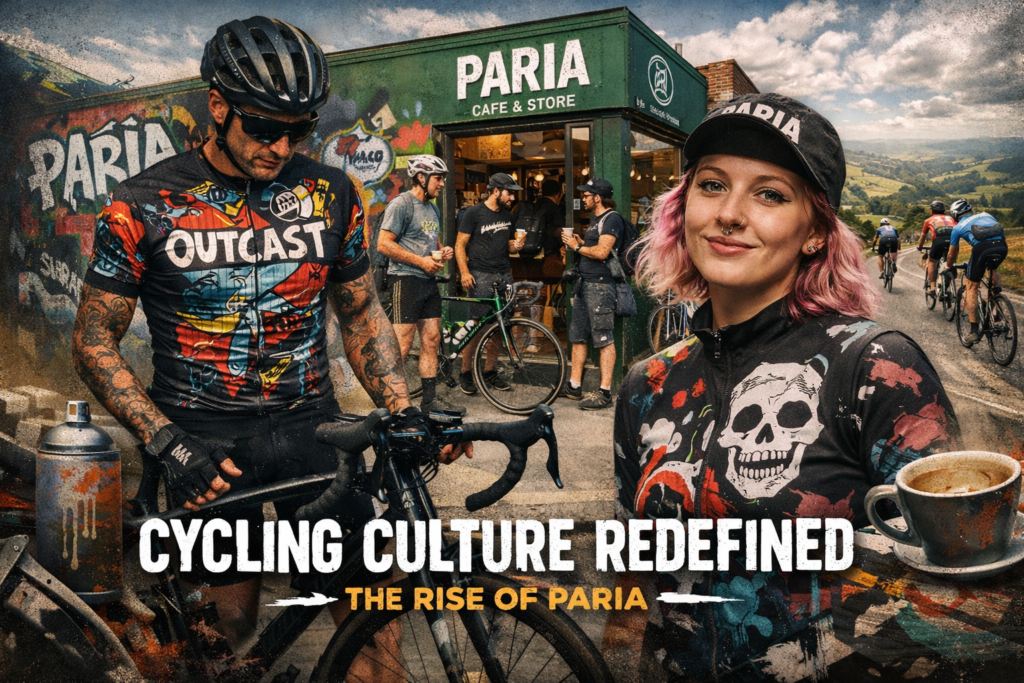
Perhaps nothing demonstrates Paria’s wider ambition more clearly than the Paria Cafe and General Store in Leeds, now celebrating over a year in operation. This is not a gimmick or a pop-up. The cafe fuses the world of cycling apparel and speciality coffee with Paria’s unique outsider vibe — and the result is a physical space where the brand’s values become a lived, daily experience.
Walk into the Paria Cafe and you are immediately transported. Rich green leather Chesterfield-style banquettes line the walls. Robin Day’s iconic Polo chairs cluster around reclaimed tables. Even the materials overhead come from repurposed PET packaging — an environmental story woven quietly into every surface. Here you can buy a jersey, drink exceptional coffee, talk about bikes, and feel genuinely welcome — regardless of how many miles you rode last week, what price point your groupset sits at, or whether you own a skin suit. That openness is not performative. It is structural. It is baked into everything Paria does.
Why Paria Matters for UK Cycling Right Now
The UK cycling apparel market is large, competitive, and full of brands demanding your attention. So why does Paria deserve yours, specifically? Because it is doing something genuinely different — and doing it with consistency, integrity, and a point of view that has never wavered from its founding principles.
What makes a brand important? Not revenue or market share — but cultural impact. Paria matters because it has fundamentally shifted what British cyclists believe is possible: that kit can be both beautiful and functional, that community can be built without exclusivity, that a brand can grow without sacrificing its soul. When grassroots clubs across the UK cite Paria as foundational to their identity, when the cafe becomes a destination for riders nationwide, when a Leeds independent challenges the assumptions of legacy brands — that is importance measured where it counts.
With over 56,000 followers on Instagram and a growing international presence, Paria has proven that a significant and passionate audience exists for cycling apparel that takes both performance and culture seriously. The brand’s growth trajectory shows no sign of slowing. It has attracted investment, expanded into running kit, deepened its community ties through events and artist collaborations, and opened a physical retail and cafe space — all while staying true to the scrappy, independent spirit that started everything.
The brand is gaining recognition and beginning to challenge larger, more established players — a fact that speaks equally to the quality of the product and the strength of the identity behind it. In a market where most challengers either drift upmarket into luxury positioning or downmarket into fast fashion, Paria holds its ground in a space entirely of its own making.
Frequently Asked Questions
Where is Paria based?
Paria is based in Leeds, Yorkshire, UK. The brand designs all products in-house at its Leeds headquarters and ships from a UK warehouse.
How much does Paria cycling kit cost?
Prices start at £12 for accessories and go up to £95 for outerwear, with jerseys and bib shorts sitting in the mid-range. The brand positions itself as genuinely accessible without compromising on quality.
Does Paria ship internationally?
Yes. Free UK and international delivery is available, with next-day UK delivery offered as a paid option.
Can I visit the Paria cafe?
Yes. The Paria Cafe and General Store is open in Leeds. It stocks the full apparel range alongside speciality coffee, making it well worth a visit if you are in Yorkshire.
Does Paria offer custom cycling kit?
Yes. Paria offers a custom kit design service for clubs and teams of all sizes, for both cycling and running clubs.
What makes Paria different from mainstream cycling brands?
Paria collaborates with independent artists on every collection, manufactures primarily in Europe and the UK, and actively builds community through events, sponsorships, and its physical cafe space — rather than simply selling kit through a website.
The Bottom Line
Cycling in the UK has, for too long, seen brands prioritise conformity over creativity and exclusivity over inclusion. Paria, built in Leeds by a Mancunian outsider with a genuine passion for two wheels and great design, represents something better — and something the sport has genuinely needed.
Whether you are a seasoned road rider clocking serious kilometres every weekend, a gravel adventurer looking for kit that can take punishment and still look sharp, a commuter who wants to Choose Bike every single day, or simply someone who appreciates the intersection of cycling and bold design — Paria has built something worth supporting. New to the brand? The Signature Jersey is the perfect place to start — it is the piece that built Paria’s reputation and remains the most versatile in the range.
Explore the full collection at paria.cc. And if you are ever in Leeds, stop by the cafe. The coffee is excellent, and the welcome is genuine.
