
If you have ever stood at the checkout on brill.com, cursor hovering between the ebook and the hardback, you are not alone. It is one of the most common decisions researchers face when buying academic publications today. Both formats have real advantages, both have genuine drawbacks, and the right answer depends almost entirely on how you work, where you are based, and what you plan to do with the material.
This guide gives you a detailed, honest comparison of Brill’s ebook and print formats in 2026 what each one offers, where each one falls short, and how to decide which choice suits your research best.
How Brill Publishes Its Books
Before comparing formats, it helps to understand how Brill approaches publication. In almost all cases, Brill publishes print and ebook editions at the same time. Both carry identical pagination, which means citations from a Brill ebook and citations from a Brill print edition are directly interchangeable. This is a deliberate and important design decision. Brill makes its ebooks available in PDF format specifically because PDF preserves the exact page layout and numbering of the print edition.
For researchers, this matters enormously. It means you do not need to choose a format based on citation compatibility. Whichever you buy, your page references will be accurate and consistent with every other version of the same title.
The Case for Brill eBooks
Immediate Access Anywhere in the World
The most obvious advantage of a Brill ebook is speed. Once you complete your purchase on brill.com, access is immediate no shipping window, no customs delay, and no waiting for a parcel. For researchers based outside Europe or the United States, where international shipping for academic books can take several weeks and carry significant import costs, this alone is a compelling reason to go digital.
Moreover, ebooks are accessible from any browser without specialist software. You can read individual chapters directly on the brill.com platform, or download the full book as a PDF for offline use. If your institution provides access to a Brill ebook through a collection purchase or Evidence Based Acquisition, you can also reach it remotely through your institutional login, meaning the material travels with you wherever you work.
Chapter-Level Access and Purchasing
One of the most useful features of the Brill ebook platform is the ability to access and purchase content at the chapter level. Rather than buying an entire edited volume to read two or three relevant contributions, you can purchase individual chapters separately. For researchers who work across multiple subject areas or who need highly specific content from a range of titles, this significantly reduces the cost of building a working reference library.
Full-Text Search
Print books cannot be searched electronically. Ebooks, on the other hand, can. On the brill.com platform, full-text search within a book is available directly from the title page. For dense academic monographs many of which run to four or five hundred pages the ability to search for a specific term, name, or concept across the entire text saves a considerable amount of time. In addition, Brill’s search-within-book function works across the main text, the footnotes, and the bibliography, making it genuinely useful for the kind of close, source-tracing work that humanities and social science research requires.
Citation Tools Built In
The brill.com platform includes built-in citation tools accessible from the blue tools ribbon on each title page. These allow you to export citation data directly into reference management software, email an ebook link to a colleague, and save titles to your personal Brill account. As a result, researchers managing large bibliographies can reduce the admin burden of citation work considerably.
Institutional Access Makes eBooks More Cost-Effective
Many academic libraries hold Brill ebook collections through institutional purchases, subject-based collections, or Evidence Based Acquisition programmes. If your institution has purchased access to a Brill ebook collection, you can reach those titles at no personal cost through your institutional login. Brill publishes approximately 1,200 ebooks per year, organised into subject-based collections across the Humanities, Social Sciences, International Law, and Biology. More than 300 ebook collections are available on the brill.com platform, with MARC21 records available for library cataloguing. Consequently, if your library holds a Brill collection in your subject area, the ebook is often the most affordable option available and frequently free at the point of use.
The Case for Brill Print Books
The Reading Experience for Long-Form Scholarship
Academic monographs are not articles. They are sustained arguments that often run to three or four hundred pages, built on accumulated evidence, extended footnotes, and careful cross-referencing. Many researchers find that reading long-form scholarship on screen even in PDF is significantly harder than reading in print. The physical process of moving through a book, marking passages, and returning to earlier sections is something a screen does not easily replicate.
For researchers who read cover to cover, annotate heavily, or work through an argument across multiple sessions, a print copy of a Brill monograph is therefore often simply more comfortable to use. This is not a sentimental preference it reflects a real difference in how long-form academic texts are best absorbed.
Physical Annotation and Marginal Notes
Print books can be written in freely. Margins can fill up with notes, questions, and cross-references. Pages can be tabbed and bookmarked. For many scholars, this physical engagement with a text is part of the research process itself. Digital annotation tools exist, but they do not fully replicate the speed and flexibility of a pencil in a margin particularly when working under time pressure or moving quickly between sources.
No Platform or Access Dependency
A print book does not require a login, a subscription, an institutional affiliation, or a working internet connection. Once you own it, you own it permanently and without conditions. Ebook access, by contrast, can shift when platform terms change, when institutional subscriptions lapse, or when your own affiliation changes. For a reference work you expect to use for decades, therefore, the permanence of print carries a practical value that is easy to underestimate until it becomes relevant.
Shelf Presence and Archival Value
For many academics, a personal library is both a working tool and a record of intellectual development. Print books carry a physical presence that reflects the breadth and depth of a scholar’s interests. They can be lent to students and colleagues, passed on to successors, and donated to libraries. In a professional context where a scholar’s library can form a meaningful part of their legacy, these are not trivial considerations.
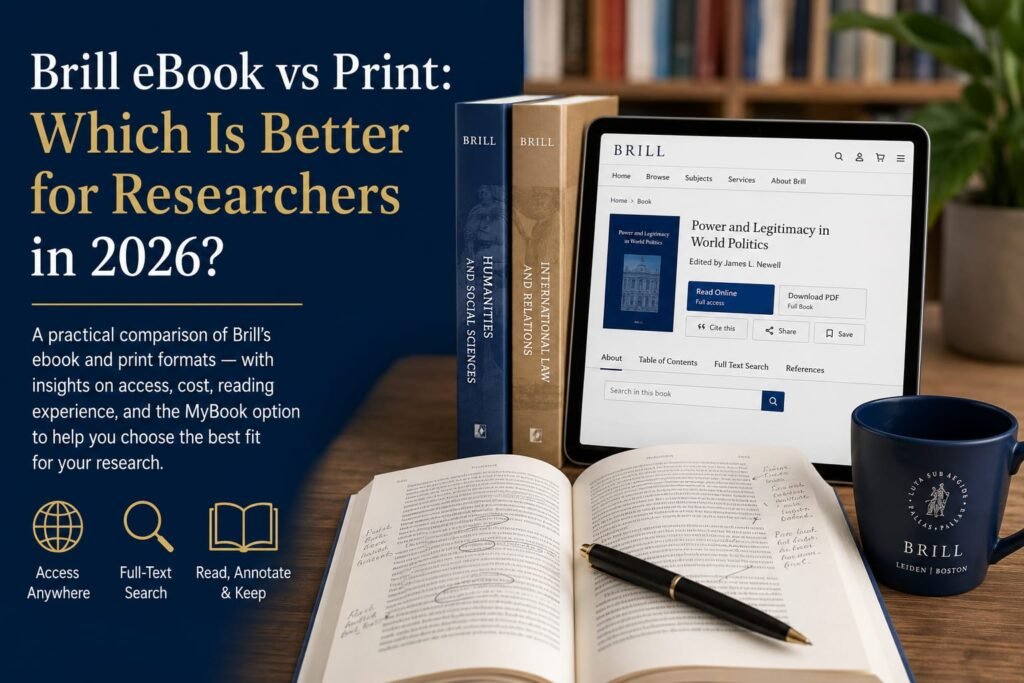
The MyBook Option: A Bridge Between Both Formats
Brill has developed a genuinely useful middle path called the MyBook programme. If you have access to a Brill ebook either through a personal purchase or through your institution you can order a print-on-demand paperback copy of that title for a fixed price of €25 / $25 per copy. Brill ships the copy free of charge, though VAT applies where relevant, and delivery takes between five and ten working days depending on your location.
MyBook copies print in black and white and exist for personal use only. A small number of titles fall outside the programme specifically books from the Ferdinand Schöningh, Wilhelm Fink, and mentis imprints due to German Buchpreisbindung regulations, titles with page size restrictions such as art books, titles that use offset printing, and currently Open Access titles. For most standard monographs and edited volumes, however, MyBook is available and represents an exceptionally affordable way to hold a physical copy of a title you already access digitally.
The practical benefit is significant. If your institution provides ebook access, you can use the digital version for research and full-text searching, then order a MyBook paperback for annotation and extended reading all for €25 / $25 plus applicable VAT. This is considerably less than the hardback price of most Brill monographs. As a result, MyBook effectively removes the either/or nature of the ebook versus print decision for many researchers.
How to Choose: A Practical Guide by Researcher Type
If You Are Based Outside Europe or the United States
Choose ebook. Shipping times and import costs for print books from Leiden can be substantial, and immediate digital access removes both problems entirely. Since the PDF format preserves identical pagination to the print edition, citation accuracy is not affected in any way.
If You Read Long Monographs Cover to Cover
Consider print, or use the MyBook programme. Extended reading on screen is harder for most people, and if a title is central to your current project, the physical copy will serve you better across weeks and months of sustained use.
If You Need to Search Across Multiple Sources Quickly
Choose ebook. Full-text search within the brill.com platform is one of the most practically useful features of the digital format, and print has no equivalent. For the kind of rapid, cross-referencing work that marks early-stage research, the ebook is faster and more flexible.
If You Are Building a Personal Research Library for the Long Term
Print offers a level of permanence that digital access cannot guarantee in the same way. However, if cost is a factor, combining institutional ebook access with MyBook paperback copies for the most important titles gives you physical ownership of key works at a fraction of the hardback price.
If Your Institution Has Brill eBook Collections
Start with what your library already provides. If your institution holds a Brill ebook collection in your subject area, you may already have access to many of the titles you need at no personal cost. From there, use the MyBook programme to add physical copies of the most important titles for €25 / $25 each.
If You Publish in Brill’s Subject Areas and Need Titles for Citation Work
Either format works well, since both carry identical pagination. However, ebook access to the brill.com platform gives you the additional benefit of direct DOI linking. Each digital text carries a Digital Object Identifier registered with CrossRef, which means individual chapters and articles can link directly. This is increasingly useful for digital citation practices and for sharing references with international collaborators.
What Stays the Same Across Both Formats
It is worth noting what the format choice does not affect. Brill applies the same peer review standards, editorial rigour, and academic quality to both formats there is no difference in content between the print and digital editions of any Brill title. Both carry the same scholarly authority and both appear in the major discovery services, including Web of Science, Scopus, Summons, Primo, EBSCO Discovery, and Google Scholar. Both also carry MARC records for library cataloguing, and the digital edition receives a DOI for stable long-term access and citation linking.
In addition, Brill has discontinued maintenance fees for institutions hosting online content. Libraries that have purchased Brill online resources no longer face ongoing hosting costs, which makes the institutional ebook model simpler and more straightforward to budget for year on year.
Brill eBook vs Print: Summary
| Factor | eBook | |
|---|---|---|
| Access speed | Immediate | Shipping: 5–10+ working days |
| Citation compatibility | Identical pagination to print | Identical pagination to ebook |
| Full-text search | Yes, via brill.com platform | No |
| Chapter-level purchase | Yes | No |
| Annotation | Digital tools available | Physical annotation, unlimited |
| Platform dependency | Requires login/access | None |
| Institutional access | Often free via library holdings | Not applicable |
| MyBook paperback option | Available from €25/$25 | N/A |
| Best for | Remote access, searching, speed | Extended reading, annotation, permanence |
Frequently Asked Questions
Are Brill ebook and print editions identical in content? Yes. Brill publishes print and ebook editions simultaneously with identical content and identical pagination, so citations from either format are directly interchangeable.
What format do Brill ebooks use? Brill ebooks are available in PDF format. This preserves the exact page layout and pagination of the print edition and meets the requirements of academic citation.
Can I buy individual chapters from Brill? Yes. Individual chapters can be purchased separately on the brill.com platform, making it possible to buy only the specific content you need from an edited volume rather than the whole book.
What is the Brill MyBook programme? MyBook allows users with ebook access either personal or institutional to order a print-on-demand paperback copy of eligible Brill titles for a fixed price of €25 / $25, with free shipping. It is available exclusively through brill.com.
Can I access Brill ebooks through my institution? Yes, if your institution has purchased a Brill ebook collection or holds individual titles. Contact your library to confirm what Brill content your institution already provides.
Do Brill ebooks require specialist software? No. Brill ebooks are readable on any browser directly on the brill.com platform, or downloadable as PDF for offline use.
Is there a quality difference between Brill’s ebook and print editions? No. Both formats go through the same editorial and peer review process, and the academic authority of a Brill title is identical regardless of which format you choose.
Final Thoughts
In 2026, the ebook versus print question at Brill is less of a binary choice than it used to be. The MyBook programme has effectively created a third option digital access combined with an affordable personal print copy that works well for a wide range of researchers. For those based far from Brill’s shipping hubs, the ebook is the clear practical choice. For those doing sustained, annotation-heavy reading of core texts, print still holds a genuine edge. And for anyone whose institution already holds Brill ebook collections, starting with what your library provides and adding MyBook copies where needed is the most cost-effective approach available in 2026.
Browse the full Brill catalogue at brill.com & Visit here https://huntmecoupons.com/store/brill/ to explore more amazing offers and save bigger with updated coupon codes.
