
For anyone navigating the world of academic publishing, the name Brill carries enormous weight. Founded on 17 May 1683 in Leiden, the Netherlands originally registered under bookseller Jordaan Luchtmans Brill has grown over more than three centuries into one of the world’s most respected scholarly publishers. Today, it publishes over 360 journals and around 2,000 new books and reference works every year, spanning humanities, social sciences, international law, biology, and far beyond.
However, for researchers, librarians, and institutions managing tight acquisition budgets, one practical question keeps surfacing again and again: between Brill eBooks and PDFs, which format actually saves more money? The answer, as it turns out, is more layered than it first appears and understanding the distinction can lead to significant savings over time.
Understanding How Brill Structures Its Digital Content
Before diving into the cost comparison, it is important to clarify something that many users initially find confusing: Brill does not offer eBooks and PDFs as two completely separate products in the traditional consumer sense. Instead, when users download a Brill eBook through the Brill Online platform, they receive the content in PDF format. According to guidance published by the University of St Andrews Library, “When downloading, Brill eBooks are only available in PDF format.”
So why does this distinction matter for cost? Because the access pathway not the file format itself determines what you pay, how long you can use the content, and under what conditions. Consequently, the real comparison worth making is between the different access models Brill offers: institutional eBook collections (accessed via subscription or perpetual license), open access PDFs, pay-per-use PDF downloads, and third-party vendor models. Each of these carries a very different price tag, and therefore, a very different value proposition.
Brill’s eBook Collections: The Institutional Route
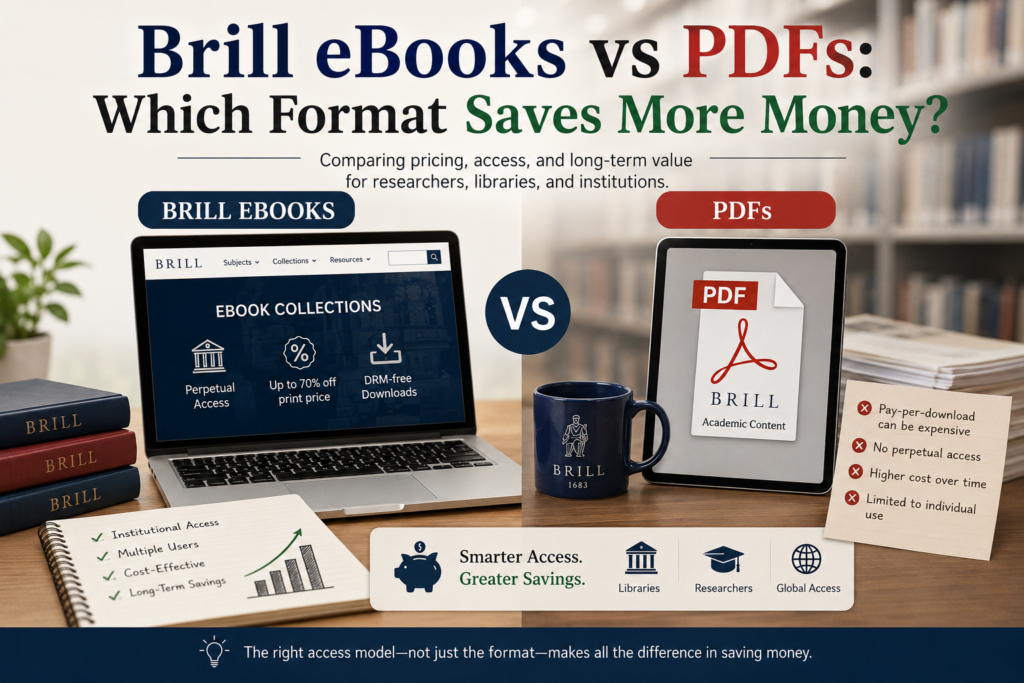
For academic libraries, the most cost-efficient route to Brill content is almost certainly through its annual eBook subject collections. Brill prices its eBook collections at 70% of the equivalent print price, according to the publisher’s own library purchasing matrix. Furthermore, libraries that purchase multiple collections in the same year receive additional volume discounts on top of that baseline reduction.
This pricing structure represents meaningful savings compared to buying individual print volumes especially when you factor in ongoing storage costs, physical wear, and the logistical burden of managing print acquisitions. Notably, Brill’s eBook collections come with no DRM (Digital Rights Management) restrictions, meaning institutions gain unlimited-user access and the freedom to download, print, and copy content as needed. The University of Cambridge Library, for instance, has been purchasing Brill’s annual subject collections since 2014, progressively replacing its print standing orders with perpetual, DRM-free digital access to nearly 1,000 titles per year.
That word “perpetual” is critical. Unlike subscription-based journal access where losing the subscription means losing access Brill’s subject eBook collections grant libraries permanent ownership of the content. This means a library that invests in a 2025 Brill collection continues to hold that access indefinitely, even if it decides not to renew the following year. In terms of long-term value, perpetual ownership substantially outweighs annual subscription models for most institutions.
The Evidence-Based Acquisition Model: Paying Only for What You Use
Beyond outright collection purchases, Brill also offers a model called Brill Evidence Select, which follows an evidence-based acquisition (EBA) approach. Under this model, libraries set a predetermined budget and gain access to Brill’s broader catalog for an agreed trial period. Usage data is collected throughout that period, and at the end of it, the library acquires perpetual access only to those titles that researchers actually used at a 1:1 ratio with the print price.
This model works particularly well for institutions that want to avoid paying upfront for large collections they may not fully use. Rather than committing to a subject-wide purchase, the EBA model ensures that every dollar spent corresponds to demonstrated demand. For resource-constrained libraries, this approach can deliver substantial savings by eliminating the waste associated with bulk purchasing of underused titles.
À La Carte PDF Downloads: Convenient but Costly
On the opposite end of the spectrum sits the Brill E-Book Select model essentially a pick-and-choose purchasing option where libraries or individuals order specific titles. Priced at a 1:1 ratio with the print edition, this route does not carry any discount over print. For a single researcher or a small institution needing only one or two titles, this might seem straightforward, but it quickly becomes expensive when multiple titles are needed.
Additionally, individual users who access Brill content without institutional subscriptions and attempt to purchase or download PDF chapters on a pay-per-use basis face some of the steepest per-chapter costs in academic publishing. Brill’s specialist subject focus covering fields like Oriental studies, Islamic studies, classical studies, international law, and Jewish studies means that its publications serve narrow scholarly communities with limited competition, which in turn keeps per-unit prices high.
As one analysis on academic publishing economics notes, Brill’s pricing reflects the reality that its publications target “disciplines with low commercial appeal but high scholarly value,” with small print runs spreading fixed editorial costs across a limited number of buyers. Therefore, accessing Brill content without any form of institutional or collective arrangement almost always represents the most expensive option available.
Open Access: The Zero-Cost PDF Option
Fortunately, there is a growing body of Brill content that costs nothing at all. Through its Brill Open program, the publisher makes a steadily expanding catalog of titles available as free, openly licensed PDFs. As of writing, over 750 Brill Open Access books are discoverable on its platform, and Brill has also made its Open Access eBook collection available via JSTOR in a completely unlimited, DRM-free model no registration, no login required.
These Open Access titles carry a CC-BY-NC license, meaning anyone can read, download, and use them freely for non-commercial purposes. For individual researchers and students who lack institutional access, this route offers the maximum possible savings: zero cost. The caveat, of course, is that Open Access titles represent only a fraction of Brill’s full catalog, and not every subject area or newly published work falls within this collection.
It is also worth noting that Brill’s Open Access publishing growth has received an institutional boost through negotiated agreements. EIFL, for example, has secured waived Article Processing Charges for corresponding authors in dozens of countries, while the Council of Australian University Librarians (CAUL) has negotiated a read-and-publish agreement that gives participating Australian universities uncapped open access publishing rights across Brill’s hybrid and gold journal portfolio. As these agreements expand globally, the volume of free-to-access Brill content continues to grow.
The De Gruyter Brill Merger: What It Means for Pricing
Another development worth factoring into any cost analysis is Brill’s 2024 merger with German academic publisher De Gruyter, forming the new combined entity De Gruyter Brill. The merger, announced in October 2023 for approximately €51.1 million, significantly expanded the combined digital catalog: De Gruyter brings over 58,000 eBooks across 29 subject areas to the table, while Brill contributes its own collection of over 30,000 titles in humanities, social sciences, and life sciences.
For libraries, this merger creates both opportunity and complexity. On the one hand, institutions that already hold subscriptions or agreements with one publisher may find it easier to negotiate bundled access that covers both catalogs. On the other hand, the consolidation of two major independent academic publishers into one entity reduces competitive pressure on pricing, which may complicate negotiations for smaller institutions without strong consortial backing.
Practical Savings Strategies: How to Get the Most from Brill Content
Given all of the above, how should different types of users approach Brill’s formats to maximize savings? The answer depends heavily on context.
For academic libraries, the eBook subject collections priced at 70% of print particularly when purchased as part of a consortium remain the most cost-effective path to large-scale, perpetual access. Libraries like Cambridge have found that replacing print standing orders with annual digital collection purchases yields consistent savings while simultaneously expanding access across their user base.
For individual researchers, the priority should always be to check whether institutional access is available first. Brill eBooks, accessible via the Brill Online platform through a library subscription, are DRM-free and allow downloading of both individual chapters and full books in PDF format. In cases where institutional access is unavailable, checking Brill’s Open Access catalog and JSTOR should come next, before considering any direct purchase.
For small or under-resourced institutions, the Brill Evidence Select (EBA) model offers a smart middle ground: it provides broad trial access without the upfront commitment of a full collection purchase, and it ensures that permanent acquisitions reflect actual user demand.
Format Features That Affect Value Beyond Price
While cost is often the primary driver of format decisions, there are functional differences between access routes that also affect overall value. Brill’s online reader supports both HTML and PDF formats for most titles with older titles available in PDF only. The HTML format offers somewhat more flexible reading and accessibility features within the browser, whereas the PDF download preserves identical pagination with the print edition, which matters enormously for academic citation purposes.
As Brill notes to prospective authors, “Our electronic publications are available in PDF format. Due to the identical pagination with the print edition, this format meets the requirements of academic citation.” This is not a trivial point. For researchers who need to cite page numbers accurately, the PDF version is functionally superior to reflowable ebook formats used by other publishers. In this respect, Brill’s choice to use PDF as its primary download format actually serves academic users well even if it limits flexibility for casual reading on mobile devices.
The Verdict: Which Format Saves More Money?
To bring everything together: the format that saves you the most money at Brill depends almost entirely on your access route, not on the file format itself because the downloaded file is always a PDF regardless.
If you have institutional access through a library that has purchased a Brill eBook collection at the 70% discount, you effectively gain perpetual, DRM-free PDF access to hundreds or thousands of titles at a fraction of individual list prices. That represents the best value available. If your institution participates in an evidence-based acquisition model, you can go even further by ensuring every acquisition dollar maps directly to demonstrated use.
If you lack institutional access entirely, Brill’s Open Access PDFs on Brill Online and JSTOR are your most powerful resource free, unlimited, and permanently available. Beyond that, the costs rise steeply, and the individual à la carte PDF purchase route offers the weakest value of all the options on the table.
In short, the key to saving money with Brill is not choosing between “eBook” and “PDF” as abstract formats it is choosing the right acquisition model and leveraging collective or institutional purchasing power wherever possible. For a publisher with roots stretching back to 1683, Brill has adapted impressively to the digital era. And for those who know how to navigate its access structures, the savings are very real indeed.
Brill is part of De Gruyter Brill, a leading independent academic publisher with offices in the Netherlands, Germany, Austria, the United States, Singapore, and China.
For further information and to avail amazing deals & discounts visit our website https://huntmecoupons.com/store/brill/.
