
If you are a musician who has spent time on Reverb, you already know it is one of the best places online to find gear at below-market prices. But if you have not explored the dedicated savings sections on reverb.com the Deals and Steals section, the Price Drops feed, and the tools that help you buy smarter you are almost certainly leaving money on the table every time you shop.
This guide covers every savings tool Reverb offers in 2026. It explains how each one works and exactly how to use them to find the biggest discounts on guitars, pedals, amps, synthesizers, pro audio gear, and everything in between.
What Is Reverb?
Reverb is the world’s largest online marketplace for buying and selling new, used, and vintage musical instruments and gear. David Kalt founded it in 2013 in Chicago as the online extension of the Chicago Music Exchange. Since then, it has grown into a platform that attracts around 27 million monthly visitors. In 2024, Reverb reported approximately $917.9 million in gross merchandise sales. Etsy acquired the platform in 2019, and it continues to operate as a standalone business within the group.
At any given time, Reverb hosts hundreds of thousands of active listings across every instrument category. These range from Fender Stratocasters and vintage Moog synthesizers to boutique overdrive pedals, studio microphones, drum kits, orchestral instruments, and DJ equipment. Roughly 80% of platform sales come from used gear, making it the go-to destination for musicians who want professional-quality instruments well below new retail prices.
Built Specifically for Musicians
Unlike eBay or Amazon, Reverb is built specifically for the music community. Every feature on the platform from the Price Guide to the condition ratings to the Deals and Steals section reflects the specific needs of musicians buying and selling gear. As a result, the platform functions both as a marketplace and as a community, connecting buyers and sellers who share a genuine passion for instruments and sound.
The Deals and Steals Section
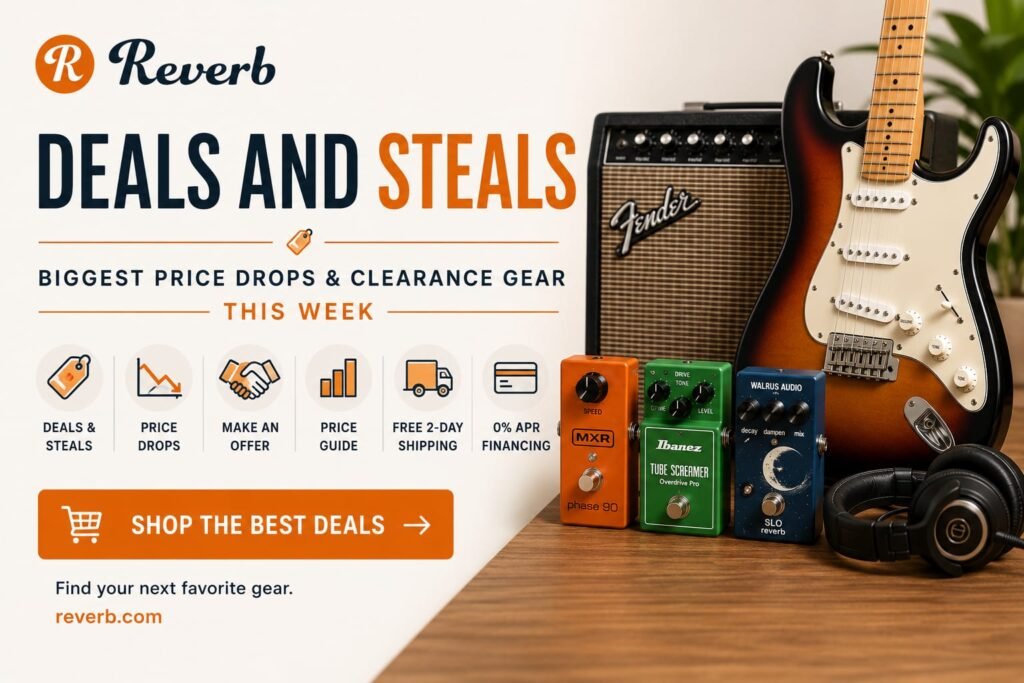
The Deals and Steals section is Reverb’s dedicated curated savings hub. It is accessible directly from the main navigation on reverb.com. The section surfaces hand-picked listings across all instrument categories where sellers have applied significant discounts. These are not random listings. Rather, they are gear that Reverb has identified as offering strong value relative to typical market prices for that item.
The section organises deals by product category, making it straightforward to browse savings in specific areas. Dedicated Deals and Steals pages exist for electric guitars, acoustic guitars, bass guitars, guitar pedals and effects, pro audio and recording equipment, synthesizers and keyboards, drums and percussion, DJ equipment, and more. Each page updates regularly as new discounted listings appear and sold items drop off.
How to Use Deals and Steals Effectively
Navigate to reverb.com and select Deals and Steals from the top navigation bar. Then choose the product category most relevant to what you are looking for. Sort results by price, condition, or how recently the deal appeared. Use the condition filters Mint, Excellent, Very Good, Good, Fair, or Poor to narrow results to the standard you want. Listings in the Excellent and Very Good categories typically offer the best balance of significant savings and reliable quality on the platform.
Check the Deals and Steals section several times a week rather than in a single visit. New listings appear continuously as sellers lower prices, and the most compelling deals at popular price points move quickly. Bookmarking the category pages you visit most is therefore one of the most effective habits a regular Reverb buyer can develop.
The Price Drops Feed
The Price Drops section is a separate and equally useful savings tool on Reverb. While Deals and Steals surfaces curated listings, Price Drops works differently. It shows listings where sellers have actively reduced the asking price on gear that was previously listed higher.
When a seller lowers a price, the listing gets promoted across the platform as a Price Drop item. It also surfaces in the dedicated Price Drops feed at reverb.com. For buyers, this is a real-time signal that a seller is motivated to move their gear. It often indicates a seller who has had a listing sitting for a while and has decided to get serious about selling. Consequently, these are exactly the kinds of sellers who may also be open to further negotiation through the Make an Offer system.
Filtering Price Drops by Category
Like Deals and Steals, the Price Drops feed is browsable by product category. If you are specifically looking for a discounted electric guitar, a reduced studio monitor, or a price-dropped synthesizer, filtering by category surfaces the most relevant results immediately. Sort by the size of the price reduction to find the most aggressively discounted listings first.
Using the Watchlist to Track Price Drops
Reverb allows buyers to add listings to a Watchlist. When the price drops on any item in your Watchlist, Reverb sends a notification — by email or through the Reverb app. This is one of the most practical tools Reverb offers for patient buyers who have a specific piece of gear in mind. Add the item you want to your Watchlist, and let Reverb notify you rather than checking back manually every day. When the seller drops to your target price, you will know immediately.
The Make an Offer System
The Make an Offer feature is one of the most powerful savings tools on Reverb. However, many buyers underuse it. On any listing where the seller has enabled offers, a Make an Offer button appears below the Add to Cart option. Clicking it opens a field where you can enter a price lower than the listing asks. The seller can then accept, decline, or counter your offer.
What the Data Says About Offers
The data behind Reverb’s offer system is worth knowing. The vast majority of accepted offers on Reverb fall between 70% and 95% of the seller’s asking price. Furthermore, a third of all orders on Reverb begin with an offer. Listings that allow offers also sell 1.5 to 2 times faster than fixed-price listings, meaning sellers who enable offers are actively motivated to negotiate. Going below 65% of the asking price will typically trigger an automatic rejection through Reverb’s Lowball Offer Policy. Keeping your offer within the 70% to 95% range therefore gives you the best chance of a successful deal.
Combining an Offer With a Price Drop Listing
One of the most effective strategies on Reverb is to use Make an Offer on listings that already appear in the Price Drops feed. A seller who has already reduced their price is signalling motivation. Making a reasonable offer on top of an already-reduced price gives you the best possible chance of landing gear at well below its original listed price and often well below fair market value too.
The Reverb Price Guide
Before making any significant purchase on Reverb, the Price Guide is an essential tool. It records every sale completed on the platform and presents the data as a clear price range for each specific instrument by condition. Search for any item in the Price Guide database which covers over 240,000 different products and you will see exactly what that gear has sold for recently, broken down by condition rating.
Two Ways the Price Guide Helps Buyers
The Price Guide serves two purposes for buyers. First, it tells you whether a listing in Deals and Steals or the Price Drops feed is actually a good deal relative to recent real-world sales, rather than just a reduction from an inflated asking price. Second, it gives you the data to make a credible offer. For example, if the Price Guide shows that a guitar in Very Good condition has sold consistently for $450 to $500 and the listing asks $575, you have a clear and defensible basis for a $450 offer.
Free 2-Day Shipping on Qualifying Listings
Reverb offers free 2-day shipping on qualifying listings from sellers who hold the Quick Shipper badge. Sellers earn this badge by consistently shipping orders within one business day of payment. Once earned, sellers can attach free 2-day shipping to their listings. Reverb then markets these listings in a curated section that buyers can filter for specifically.
For buyers who want gear quickly or who simply want to avoid paying shipping on top of the item price filtering for free 2-day shipping is a practical way to narrow results to reliable, responsive sellers. The filter is available in the search results sidebar on reverb.com. It is worth noting, however, that free 2-day shipping does not apply to orders placed through the Make an Offer system. It applies only to direct purchases at the listed price.
0% APR Financing Through Affirm
For larger purchases a vintage guitar, a studio recording setup, or a quality amplifier Reverb offers 0% APR financing through Affirm. At checkout, you can choose Affirm as your payment method and select from 3, 6, 12, 18, 24, or 36 monthly payment plans. As an example, a $525 purchase might cost $30 per month at 0% APR for 18 months.
The 0% APR rate is available to qualifying US residents and requires a credit eligibility check. Actual rates range from 0% to 30% APR depending on creditworthiness. This option is particularly useful when a deal appears on a higher-value item but your immediate budget is limited. Spreading the cost over monthly payments at 0% means the gear costs no more than the sale price and you can act on a time-sensitive deal before it disappears.
Reverb Gives: Shopping With a Social Dimension
Every purchase on Reverb supports two causes through the Reverb Gives programme. First, a portion of every sale supports youth music programmes by helping them access the gear they need. Second, purchases help protect forests, including trees traditionally used to make instruments. Neither commitment changes the price you pay or the way you shop both are built into the platform automatically. Nevertheless, they reflect something genuine about what Reverb is trying to do as a company, and they are worth knowing about as a buyer.
How to Find the Best Deals on Reverb: A Practical Summary
Step 1 – Start With Deals and Steals
Begin every Reverb session in the Deals and Steals section for your target category. This is the fastest way to surface significantly discounted gear that Reverb has already curated as strong value. Bookmark the category pages you visit most and check them several times a week.
Step 2 – Cross-Reference With the Price Guide
Before committing to any purchase, check the Price Guide for the specific item you are considering. Confirm that the listed price even a discounted one sits at or below recent sale prices for that item in comparable condition. If it does, you have a genuine deal. If it does not, you then have the data to make a credible offer.
Step 3 – Add Targets to Your Watchlist
For any gear you want but are not ready to buy at the current price, add it to your Watchlist. Reverb will notify you when the price drops, saving you the effort of monitoring manually. As a result, you will not miss a reduction on something you genuinely want.
Step 4 – Use Make an Offer on Price Drop Listings
When a listing already appears in the Price Drops feed, the seller is motivated to move the item. Make a reasonable offer ideally supported by Price Guide data in the 70% to 95% range of the current asking price. This combination of a seller-initiated reduction and a buyer offer is where the deepest discounts on Reverb consistently happen.
Step 5 – Filter for Free 2-Day Shipping
When your search results are broad, narrow them with the free 2-day shipping filter. This surfaces listings from Quick Shipper sellers who have removed shipping costs from the equation. Consequently, it gives you a cleaner comparison of the actual item price across competing listings.
Step 6 – Use Affirm for Larger Purchases
When a deal appears on a higher-value item and your immediate budget is limited, select Affirm at checkout. Qualifying buyers can spread the cost over monthly payments from 0% APR. This makes it possible to act on a time-sensitive deal without waiting until the full amount is available and without paying more than the sale price.
Reverb: Key Facts at a Glance
- Founded: 2013 in Chicago by David Kalt
- Acquired by: Etsy (2019)
- Monthly visitors: Approximately 27 million
- Gross merchandise sales (2024): Approximately $917.9 million
- Used gear share: Approximately 80% of all platform sales
- Price Guide database: Over 240,000 products
- Seller fee: 5% of sale price, capped at $500 — no listing fees
- Savings sections: Deals and Steals, Price Drops
- Financing: 0% APR through Affirm (US residents, subject to eligibility)
- Shipping: Free 2-day shipping on qualifying listings from Quick Shipper sellers
- Where to shop: reverb.com
Frequently Asked Questions
What is the Deals and Steals section on Reverb? Deals and Steals is Reverb’s curated savings hub. It features hand-picked listings across all instrument categories where sellers have applied significant discounts. It is accessible from the main navigation on reverb.com and organises deals by product category.
What are Price Drops on Reverb? Price Drops are listings where sellers have actively reduced the asking price from a previously higher figure. Reverb surfaces these in a dedicated Price Drops feed and promotes them across the platform when a seller lowers their price.
How does Make an Offer work on Reverb? On listings where sellers have enabled offers, buyers can submit a lower price through the Make an Offer button. The vast majority of accepted offers fall between 70% and 95% of the asking price. Offers below 65% of the asking price trigger an automatic rejection through Reverb’s Lowball Offer Policy.
Does Reverb offer free shipping? Free 2-day shipping is available on qualifying listings from sellers with the Quick Shipper badge. Shipping policies vary by individual seller. Furthermore, free 2-day shipping does not apply to orders placed through the Make an Offer system.
Does Reverb offer financing? Yes. Reverb offers financing through Affirm for qualifying US residents. Payment plans of 3, 6, 12, 18, 24, or 36 months are available at checkout, with rates from 0% APR based on credit eligibility.
How does the Reverb Price Guide work? The Price Guide records every completed sale on Reverb and shows the price range for each specific instrument by condition. It covers over 240,000 products and is free to use at reverb.com/price-guide.
Is Reverb safe to buy from? Yes. Reverb offers buyer and seller protection on all transactions through Reverb Protection. The platform processes payments securely through Reverb Payments, and buyers have recourse through Reverb’s support team if an order does not arrive as described.
Final Thoughts
Reverb is not simply a place to browse used gear. It is a platform built around the idea that musicians deserve access to great instruments at fair prices. The Deals and Steals section, the Price Drops feed, the Make an Offer system, the Price Guide, free 2-day shipping on qualifying listings, and 0% APR financing through Affirm all work together. Together, they give buyers every tool needed to find and act on the best deals available at any given moment.
The key to getting the most from Reverb is using these tools together rather than in isolation. A Price Guide check before an offer, a Watchlist notification before a purchase, a Deals and Steals browse before a direct search these habits, repeated consistently, are how musicians find exceptional gear at prices that would not be possible anywhere else.
Browse the full Reverb catalogue and explore the latest deals at reverb.com & visit here https://huntmecoupons.com/store/reverb/ to explore more amazing offers and save bigger with updated coupon codes.
