
Business risk does not follow a schedule. A supplier can fail a compliance audit on a Tuesday morning. A key executive can depart on a Friday afternoon. A regulatory change can take effect before your team even sees it. By the time your next quarterly review arrives, the damage is already underway. Real-time risk monitoring exists to close that gap. This guide walks you through exactly how to do it, step by step, using Riskify an AI-powered risk intelligence platform built for businesses of every size.
Why Real-Time Risk Monitoring Matters
Most organisations still rely on periodic risk reviews. They run due diligence when onboarding a new supplier, then check in again at the next annual review. That approach leaves months of blind spots in between. During that window, a vendor can accumulate regulatory violations, experience a leadership crisis, or suffer a cybersecurity breach. You only find out when it affects you directly.
Real-time monitoring changes the model. Instead of waiting for a scheduled review, you receive continuous intelligence as events unfold. Risks surface early, when you still have time to respond. This is the core reason risk and compliance professionals, procurement teams, financial services firms, and ESG-focused investors are moving toward always-on monitoring.
Riskify makes this accessible without requiring a technical team or a complex setup. Its AI engine continuously analyses data across six risk categories and surfaces insights the moment they become relevant. Furthermore, it tracks over 60 million companies worldwide, so whether you are monitoring a direct supplier or a competitor, the platform has coverage.
Step 1: Define Which Companies You Need to Monitor
Before you start monitoring, you need to be clear about who matters to your business. Real-time risk monitoring is most valuable when it covers the right entities.
Start by mapping your exposure. Consider your key suppliers and vendors, your strategic partners, your largest customers, your competitors, and any companies in your investment or lending portfolio. Each of these relationships carries risk. A supplier failure disrupts your operations. A partner’s regulatory problem can create reputational exposure for you. A competitor’s workforce instability may signal market shifts worth tracking.
Once you have your list, prioritise. The companies with the highest impact on your operations or reputation deserve the most frequent monitoring. For paid plans, Riskify allows continuous monitoring of up to five companies on the Professional plan. The Elite plan extends that to 20. Enterprise users get a customised number with no fixed ceiling. For those just getting started, the free plan lets you run one-time scans on up to three companies at no cost and with no credit card required.
Step 2: Set Up Your Riskify Account
Getting started with Riskify takes minutes. Visit riskify.net and sign up. No technical knowledge is required, and the platform is built for business professionals rather than IT teams.
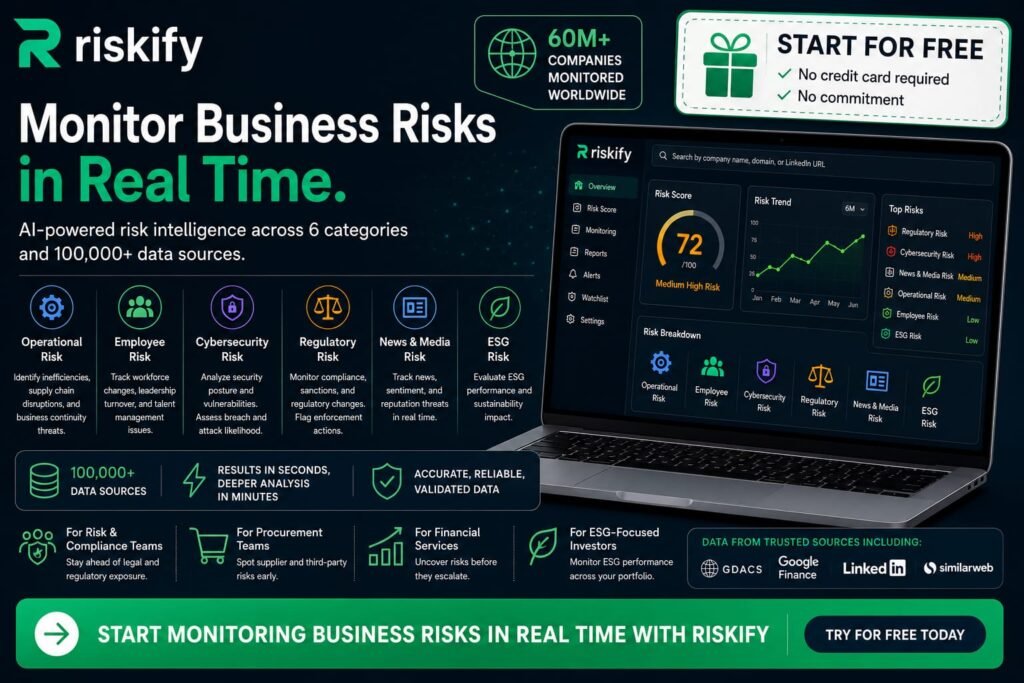
Once inside, the interface is straightforward. The main action is a search bar where you enter a company name, website domain, or LinkedIn URL. Riskify’s AI immediately locates the company and begins a comprehensive risk scan. Initial insights appear within seconds. Deeper analysis completes within minutes.
For ongoing monitoring, paid plans automatically scan your selected companies at weekly intervals. You do not need to log in and run searches manually. Instead, the platform alerts you when something changes, so your attention goes to the risks that matter rather than the process of finding them.
Step 3: Run Your First Risk Scan
With your account set up, run a risk scan on your highest-priority company first. Enter the company name or domain into the search bar. Riskify’s AI then pulls data from global news, social media, financial reports, regulatory filings, court records, and litigation and sanctions watchlists. In total, it draws on more than 100,000 sources. Specialised datasets from organisations including GDACS, Google Finance, LinkedIn, and Similarweb contribute to the analysis.
The result is a comprehensive risk profile covering six categories. Understanding each one helps you know where to look first.
Operational Risk highlights inefficiencies or vulnerabilities in the company’s business operations that could affect its performance or your relationship with it.
Employee Risk tracks workforce changes, leadership turnover, and talent management issues. Leadership departures are often early indicators of deeper structural problems.
Cybersecurity Risk analyses the company’s security posture and known vulnerabilities. It assesses the likelihood of breaches or cyberattacks based on publicly available data.
Regulatory Risk reviews the company’s regulatory standing and flags legal exposure, sanctions, compliance violations, or enforcement actions.
News and Media Risk monitors public sentiment and media coverage in real time. It detects reputational threats including negative press and significant shifts in public opinion.
ESG Risk assesses the company’s environmental, social, and governance practices. This is particularly relevant for investors and organisations with sustainability commitments. Furthermore, ESG scores are increasingly factored into procurement and partnership decisions.
Each category comes with a risk score. These scores give you a quick overview and also allow you to drill deeper into the specific areas that concern you most.
Step 4: Interpret Your Risk Scores
Riskify’s risk scores are designed for fast, informed decision-making. Rather than reading through raw data, you get a structured view of where risk is elevated and where it is not.
When you see a high score in a category, that is your signal to investigate further. Click into the score to see the underlying data points driving it. For regulatory risk, this might mean a recent enforcement action or a new compliance requirement that affects the company’s market. For employee risk, it might mean a pattern of senior departures or a significant reduction in workforce size. For cybersecurity risk, it might mean recently disclosed vulnerabilities or a known data incident.
A low score does not mean no risk exists. Rather, it means the data available at that point in time does not indicate elevated concern. Because Riskify monitors continuously, scores update as new data arrives. Consequently, a company that looks clean today can surface a new signal tomorrow, and you will be alerted without having to check manually.
Use the scores as a triage tool. Review high-scoring categories first, then build your response based on the specific data behind the score.
Step 5: Enable Continuous Monitoring and Alerts
A one-time scan gives you a snapshot. Continuous monitoring gives you a moving picture. This distinction is important because risks evolve. A supplier that passes your initial due diligence can develop problems six months later.
On Riskify’s paid plans, continuous monitoring runs automatically at weekly intervals. The platform scans your selected companies, compares results against previous data, and alerts you to meaningful changes. You do not need to log in to discover a new risk. Instead, the alert comes directly to you.
This is where real-time monitoring delivers its full value. A compliance officer monitoring a portfolio of vendors does not need to spend hours each week manually checking each one. Similarly, a procurement team tracking a supply chain does not need to run new searches every time they want a current picture. The platform handles the scanning, and the professional handles the response.
Exportable PDF reports are also available on paid plans. These make it straightforward to document risk findings for internal review, share them with a board, or include them in a due diligence file.
Step 6: Use Riskify for Due Diligence and Background Checks
Continuous monitoring is not the only use case. Riskify is also a powerful tool for point-in-time due diligence and background checks. Before onboarding a new supplier, a thorough risk scan gives you the intelligence to proceed with confidence. The same applies before entering a partnership or making an investment decision. You get to ask better questions — or walk away early — based on real data rather than assumption.
Because Riskify monitors over 100 million companies worldwide, you can scan virtually any organisation you encounter. This includes public companies, private enterprises, startups, non-profits, and government entities across every industry and geography. The platform requires only a company name, website domain, or LinkedIn URL to begin.
For procurement teams, this means supplier risk assessment becomes fast and repeatable rather than slow and inconsistent. For financial services professionals, it means uncovering non-financial risks before they affect a lending or investment decision. For compliance officers, it means background checks that go far beyond a basic internet search.
Step 7: Monitor Competitors and Partners, Not Just Risks
One of the less obvious applications of real-time risk monitoring is competitive and partner intelligence. Riskify is built not just to protect you from threats but to keep you informed about the organisations that matter to your business decisions.
Monitoring a competitor’s employee risk profile, for example, can signal workforce instability that precedes a strategic shift. Tracking their news and media risk can reveal reputational challenges before they affect market dynamics. Monitoring an ESG score can surface governance concerns before they become public controversy.
For partners, the value is equally clear. A partner’s regulatory risk score rising over several weeks is an early warning to revisit the relationship. A cybersecurity risk flag on a technology vendor gives you time to review data sharing arrangements before a breach occurs.
Riskify’s dashboard supports monitoring multiple companies simultaneously. This makes it practical to maintain a live view of your entire risk landscape rather than managing separate tools for each category of relationship.
Choosing the Right Riskify Plan
Riskify offers four plans to match different monitoring needs.
The Free plan costs nothing and requires no credit card. It generates one-time risk reports for up to three companies. This is the right starting point for anyone who wants to evaluate the platform before committing.
The Professional plan at $79 per month covers continuous weekly monitoring of up to five companies. It includes up to 30 reports per month and advanced report access. It suits small teams with a defined set of key vendors or partners to track.
The Elite plan at $199 per month extends coverage to 20 companies with up to 120 reports per month. This tier is ideal for organisations running active vendor management programmes, investment monitoring workflows, or multi-supplier due diligence processes.
The Enterprise plan offers custom pricing, unlimited monitoring, API access, custom contracts, and a dedicated account manager. It is the right choice for large organisations that need to monitor at scale or integrate Riskify’s data directly into their existing systems.
Annual billing is available on all paid plans, often at a lower effective rate than monthly billing. Cancellation is permitted at any time, with access continuing until the end of the current billing period.
Tips for Getting the Most from Real-Time Risk Monitoring
Setting up monitoring is only the first step. To get full value from Riskify, a few practical habits make a significant difference.
Review alerts promptly. When Riskify flags a change, act on it quickly. The advantage of real-time monitoring is the time it buys you. However, that advantage disappears if alerts sit unreviewed for days.
Use risk scores comparatively. A single score tells you the current picture. Comparing scores over time tells you whether a company’s risk profile is improving or deteriorating. Specifically, a regulatory score that trends upward over several weeks deserves more attention than a one-time spike.
Share reports with decision-makers. Riskify generates exportable PDF reports on paid plans. Use these to bring risk intelligence into board meetings, procurement reviews, and investment decisions, rather than keeping it siloed in the risk team.
Combine monitoring categories. The six risk categories work best together. For example, a company showing elevated employee risk and rising news and media risk at the same time is a stronger warning signal than either category in isolation. Consequently, reviewing all six categories before making a decision gives you a fuller picture than focusing on one.
Start with the free plan. Before committing to a paid tier, run three scans on the companies that matter most to you. The results will show you the depth of insight the platform delivers and help you choose the right plan for your needs.
Final Thoughts
Real-time risk monitoring is no longer a capability reserved for large enterprises with dedicated risk teams and expensive software stacks. Riskify makes it accessible to any business, at any size, with no technical setup required. From your first scan to continuous weekly monitoring across an entire supplier and partner network, the platform gives you the intelligence to act early rather than react late.
The six risk categories operational, employee, cybersecurity, regulatory, news and media, and ESG give you a structured view of where exposure exists and where it is growing. The risk scores make triage fast. The continuous monitoring makes the whole process automatic.
Start with the free plan, run your first three scans, and see what you have been missing.
Start monitoring business risks in real time with Riskify & Don’t Forget to visit https://huntmecoupons.com/store/riskify/ for more exclusive deals & latest coupon codes.
