
Risk is no longer something businesses can afford to monitor manually. In 2026, the volume, velocity, and variety of threats facing modern enterprises from ESG violations and regulatory penalties to cybersecurity breaches and reputational crises have grown far beyond the capacity of spreadsheets and quarterly audits. Consequently, businesses across industries are turning to AI-powered risk monitoring tools to stay ahead of the curve.
But not all AI risk tools are created equal. While many platforms focus exclusively on financial risk, a growing and critically underserved category of threats non-financial risks continues to catch businesses off guard. These are the risks that don’t show up in balance sheets but absolutely show up in headlines, regulatory investigations, and broken supply chains.
In this post, we break down what to look for in an AI risk monitoring tool in 2026, explore the key risk dimensions every business should cover, and highlight why Riskify stands out as a leading solution in this space.
Why AI Risk Monitoring Has Become Non-Negotiable in 2026
Not long ago, risk management was largely a backward-looking function. Teams would review reports, compile audits, and respond to incidents after they occurred. Today, however, the pace of global business demands something fundamentally different: proactive, real-time intelligence that flags emerging threats before they escalate.
Artificial intelligence has transformed this dynamic entirely. Modern AI risk monitoring tools continuously scan thousands of data sources news outlets, regulatory filings, sanctions lists, cybersecurity databases, and more and distill all of that raw signal into structured, actionable intelligence. As a result, risk teams can now identify a sanctions violation, a reputational controversy, or an operational disruption within hours, rather than weeks.
Furthermore, businesses today operate within increasingly complex ecosystems. Supply chains span multiple continents. Vendor networks run deep. Regulatory environments shift frequently. In this context, manual risk screening is not just inefficient it is dangerous. The businesses that thrive in 2026 are those that treat risk monitoring as a continuous, automated function rather than a periodic exercise.
What to Look for in an AI Risk Monitoring Tool
Before selecting a platform, businesses need to understand what separates a genuinely capable AI risk monitoring tool from one that merely uses AI as a marketing label. Here are the most important criteria to evaluate:
1. Coverage Across Multiple Risk Dimensions
Financial risk models have long dominated enterprise risk management. However, the most impactful threats in recent years ESG controversies, regulatory actions, cyberattacks, workforce instability are distinctly non-financial in nature. Therefore, any serious AI risk monitoring platform must cover a broad spectrum of risk types, not just credit or market risk.
2. Real-Time Data Processing
Risk intelligence is only valuable when it is timely. A tool that delivers weekly or monthly snapshots cannot support fast business decisions. Look for platforms that continuously ingest and process data, delivering insights as events unfold.
3. Multiple, Verified Data Sources
A single data source creates blind spots. Strong AI risk platforms aggregate data from proprietary datasets, professional providers, and trusted public records then verify and normalize that data before surfacing it to users.
4. Explainability and Traceability
AI outputs are only useful when decision-makers understand why a risk signal was flagged. Platforms that provide source-linked, explainable intelligence allow compliance and risk teams to act with confidence and remain audit-ready.
5. Seamless Integration
Risk intelligence must flow into the systems where decisions are made compliance workflows, GRC platforms, BI dashboards, and even AI models. API-first architectures are therefore far more valuable than siloed, standalone interfaces.
The Six Risk Dimensions Every Business Must Monitor
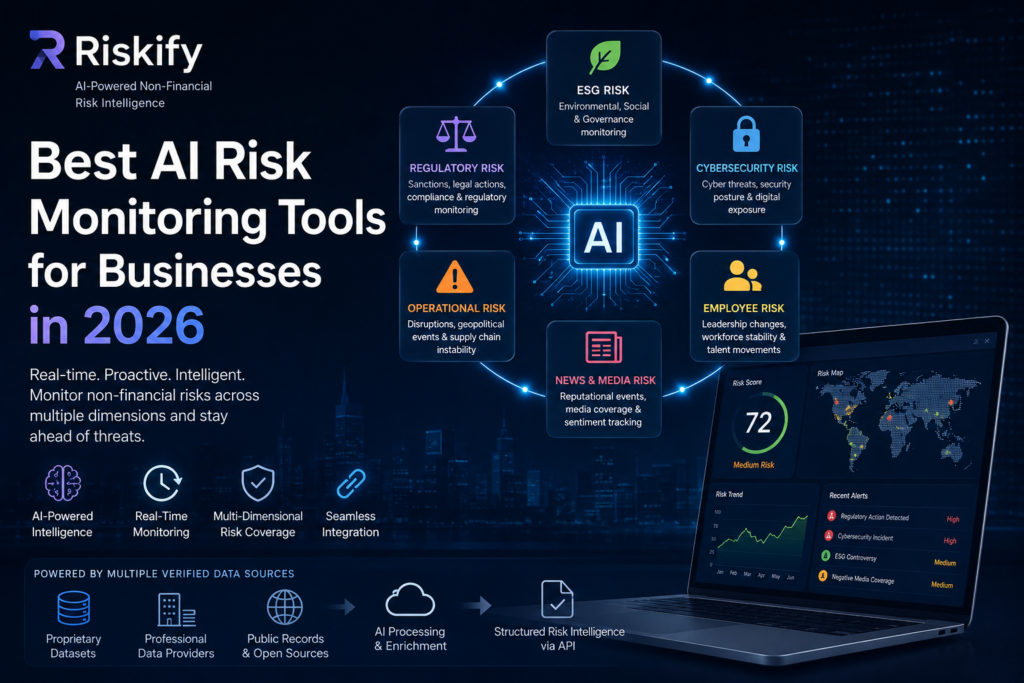
One of the most important shifts in enterprise risk management is the growing recognition that non-financial risks carry enormous business consequences. Specifically, there are six core risk dimensions that organizations need to monitor continuously in 2026:
ESG Risk covers environmental and social standards, sustainability certifications, and controversies related to labor practices or environmental impact. As regulatory pressure on ESG disclosures intensifies globally, this dimension has moved from optional to essential.
Regulatory Risk encompasses sanctions, legal actions, regulatory penalties, and restricted-party lists. Missing a sanctions update or failing to catch a regulatory violation during vendor onboarding can expose a business to severe legal and financial consequences.
Cybersecurity Risk includes security certifications, technical posture indicators, and digital exposure signals. Given that supply chain cyberattacks have become one of the most common threat vectors, monitoring counterparties’ cyber posture is no longer optional.
Operational Risk refers to disruptions driven by natural disasters, geopolitical conflict, or macro-level events that affect an entity’s ability to operate. Businesses with global supply chains are especially vulnerable to operational shocks that originate far from their own operations.
Employee and Workforce Risk captures signals related to leadership changes, workforce instability, and talent movement. A sudden executive departure or a pattern of employee turnover can indicate deeper organizational problems that affect business relationships.
News and Media Risk tracks reputation-shaping events, media coverage trends, and narrative shifts around companies and their key figures. Reputational damage often moves faster than financial consequences, making early detection especially valuable.
Introducing Riskify: AI-Powered Non-Financial Risk Intelligence
Among the AI risk monitoring tools available in 2026, Riskify has distinguished itself as a purpose-built platform for non-financial risk intelligence. Rather than competing with financial risk systems, Riskify is specifically designed to complement them adding the non-financial dimensions that traditional models routinely miss.
What Riskify Does
Riskify delivers real-time company risk insights across all six non-financial risk dimensions: ESG, Regulatory, Cybersecurity, Operational, Employees, and News & Media. It aggregates data from three distinct layers proprietary datasets, professional third-party providers, and trusted public records then applies advanced AI models to transform that raw data into structured, explainable risk intelligence.
The platform’s AI intelligence engine operates through a five-step pipeline. First, it continuously ingests signals from data sources across geographies. Next, it normalizes and standardizes records into unified entity profiles. Following that, AI models classify events and attributes into the appropriate risk dimensions. The engine then contextualizes each signal by adding metadata, severity ratings, timestamps, and geographic context. Finally, it delivers structured risk profiles through RESTful APIs for real-time integration.
This end-to-end pipeline means that Riskify users receive not just data, but intelligence signals that are already classified, contextualized, and ready to act on.
Key Use Cases
Vendor and Third-Party Due Diligence. One of the most immediate applications of Riskify is automating risk screening for new vendors, partners, or acquisition targets. Instead of conducting manual reviews, teams can instantly enrich entity profiles with verified non-financial intelligence across all six risk dimensions. Several users on G2 have noted that Riskify dramatically accelerates their pre-engagement analysis, allowing them to assess potential partners’ risk profiles before signing contracts.
Continuous Counterparty Monitoring. Beyond initial onboarding, Riskify enables ongoing monitoring of suppliers, clients, and investment targets. This means that when a risk event occurs a regulatory penalty, an ESG controversy, a cybersecurity incident the relevant teams receive alerts in real time, rather than discovering the issue weeks later through a manual review.
Compliance and Regulatory Oversight. Riskify helps compliance teams identify sanctions, lawsuits, and ESG violations faster than traditional document-based review processes. Because the platform is designed with source traceability and clear audit trails, teams can remain audit-ready without additional manual documentation.
Enriching Financial Risk Models. For organizations that already have financial risk scoring systems in place, Riskify adds a critical non-financial layer. By integrating ESG, regulatory, and reputational risk signals alongside credit and market data, risk teams achieve a genuinely holistic view of entity risk.
Powering AI and LLM Applications. Riskify’s structured, real-time data is also well-suited to feeding AI models and large language model applications. As enterprises increasingly build AI-driven decisioning and risk-aware agents, high-quality non-financial risk data becomes a foundational input.
What Users Are Saying
Riskify holds a 4.9 out of 5.0 rating on G2, based on verified user reviews. Across those reviews, several themes emerge consistently.
Users highlight the platform’s real-time risk monitoring as a standout capability, noting that it enhances their ability to respond quickly to emerging threats. Reviewers also praise the in-depth reporting, the comprehensive view of organizational risk profiles, and the user-friendly interface that makes navigation and report generation straightforward.
One G2 reviewer, a Manager in the Computer & Network Security industry, described Riskify as “hands down the best non-financial risk management solution for businesses” they had encountered, specifically citing the speed of AI-generated reports and the simplicity of generating daily insights.
Another reviewer, a Lead Generation Specialist, noted that Riskify accelerated their company analysis process significantly: having an overview of a potential partner’s risk status allows their team to anticipate what work will be required and structure proposals more effectively. The ability to generate reports instantly, they added, creates a ready-made tool that strengthens the perceived value of their offers during client negotiations.
A Chief Operations Officer in the marketing and advertising sector highlighted Riskify’s value in pre-deal due diligence, explaining that the platform provides a preview of the risk landscape before making formal proposals ultimately increasing negotiation confidence.
How Riskify Integrates
Riskify is built around a RESTful API architecture, which means it connects directly into existing workflows and systems. Development and data teams can embed non-financial risk intelligence into compliance platforms, GRC systems, business intelligence dashboards, and custom AI applications. Importantly, the platform is available through RapidAPI, which lowers the barrier to integration and allows teams to start enriching their risk workflows in days rather than months.
This API-first design reflects a broader philosophy: risk intelligence should be as accessible and programmable as any other enterprise data stream. Rather than forcing risk teams to work within a separate portal, Riskify delivers intelligence directly into the tools and workflows where decisions are already happening.
How to Choose the Right AI Risk Monitoring Tool for Your Business
With a clearer picture of what strong AI risk monitoring looks like, here is a practical framework for evaluating your options:
Start with your risk exposure. Identify which risk dimensions are most material to your industry and business model. If you operate a global supply chain, operational and regulatory risk should be top priorities. If you manage a large vendor network, ESG and reputational risk monitoring become especially important.
Assess your integration requirements. Determine how risk intelligence needs to flow into your existing systems. If your team works primarily within a GRC platform or BI environment, you need a tool that delivers data through APIs rather than isolated dashboards.
Evaluate data quality and sourcing. Ask vendors to explain where their data comes from, how it is verified, and how frequently it is updated. Platforms that blend proprietary, professional, and public data and can trace outputs back to their sources offer significantly higher reliability.
Consider scalability. Your risk monitoring needs will grow as your business grows. Choose a platform that can scale from screening individual entities to monitoring enterprise-wide portfolios without requiring major re-architecture.
Look for explainability. Especially for compliance purposes, your risk intelligence platform must provide context alongside its outputs. Risk scores without supporting signals and source attribution are difficult to act on and impossible to audit.
Final Thoughts
AI risk monitoring is no longer a competitive advantage it is a baseline requirement for businesses that operate in complex, fast-moving environments. In 2026, the question is not whether to invest in AI risk intelligence, but which dimensions to cover and which platforms to trust.
Riskify addresses a genuine and persistent gap in the enterprise risk management landscape: the non-financial risks that traditional financial models overlook, but that regulators, customers, and counterparties increasingly scrutinize. By delivering real-time, AI-powered intelligence across ESG, Regulatory, Cybersecurity, Operational, Employee, and News & Media dimensions through a flexible, API-ready architecture Riskify equips businesses to monitor risk continuously, make faster decisions, and build more resilient operations.
For teams that are ready to move beyond manual screening and periodic audits, Riskify offers a clear path forward: structured, explainable, real-time non-financial risk intelligence that integrates directly into the workflows where it matters most.
Ready to see Riskify in action? Explore the API on RapidAPI or visit riskify.net to learn more, also visit our site https://huntmecoupons.com/store/riskify/ and find out about Riskify’s current running deals and discounts.
