
Choosing between two great drones is never easy. The DJI Mini 4 Pro and the DJI Air 3S are both outstanding cameras in the sky but they are built for very different people. One fits in your jacket pocket and skips registration paperwork in most countries. The other shoots like a professional cinema rig and laughs at wind gusts that would send lighter drones scrambling for cover.
So which one is right for you? In this comparison, we break down every key difference from camera specs and flight performance to price and portability so you can make the right call before spending your money.
The Quick Summary
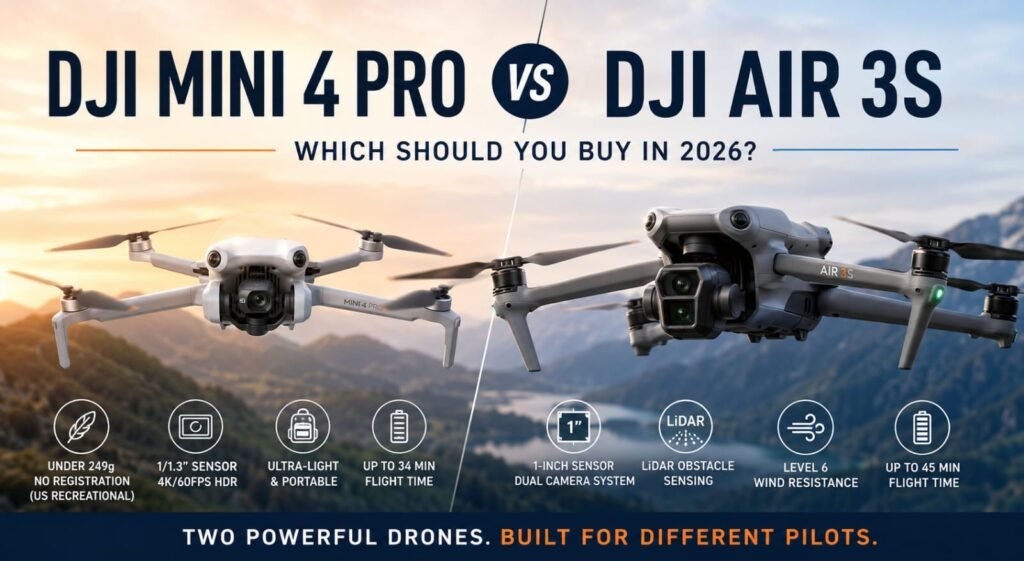
The DJI Mini 4 Pro starts at $759 and weighs under 249 grams. That sub-250g weight is its superpower: recreational flyers in the US, UK, and most of Europe do not need to register it with aviation authorities. It shoots 4K video, carries a capable 1/1.3-inch sensor, and fits inside a daypack without any fuss.
The DJI Air 3S starts at $1,099 and weighs 724 grams. It carries a dual-camera system with a 1-inch primary sensor, a forward-facing LiDAR sensor the first on any consumer drone and Level 6 wind resistance. It is the more powerful machine in almost every measurable way.
The $340 gap between them is real. Whether it is worth it depends entirely on what you plan to shoot and where.
Camera Quality: A Clear Gap in Low Light and Flexibility
This is where the two drones differ most. The Mini 4 Pro uses a single 1/1.3-inch CMOS sensor with a 48MP resolution and an f/1.7 aperture. It shoots 4K up to 60fps in HDR, supports 10-bit D-Log M colour profiles, and handles daylight and golden hour beautifully. For travel content, social media, and casual creative work, it produces footage that would have cost ten times as much to capture just a few years ago.
The Air 3S, however, operates on a different level. Its primary camera uses a full 1-inch CMOS sensor physically larger than the Mini 4 Pro’s — which captures significantly more light. That translates directly into cleaner footage in low light, richer dynamic range, and more detail in highlights and shadows. Both cameras on the Air 3S deliver up to 14 stops of dynamic range, and the drone supports 4K up to 120fps in D-Log M.
Beyond the sensor size, the Air 3S adds a second camera: a 1/1.3-inch medium telephoto lens at 70mm with 3x optical zoom. That second lens is not a gimmick. In practice, it gives you creative options that a single-camera drone simply cannot match tight portrait shots from a safe distance, compressed perspectives, the ability to reframe without repositioning the drone mid-flight.
For daylight shooting in good conditions, both drones produce impressive results. Step into low light, twilight, or a challenging high-contrast scene, and the Air 3S pulls noticeably ahead.
Winner: DJI Air 3S by a significant margin for serious creators. The Mini 4 Pro holds its own for casual and social content in good conditions.
Flight Performance: Wind Resistance, Speed, and Altitude
The Air 3S is the stronger flyer. Its 724g weight and more powerful motors give it Level 6 wind resistance, meaning it handles gusts up to 12 m/s (43 km/h) without losing stability. The Mini 4 Pro is rated at Level 5, handling winds up to 10.7 m/s (38.5 km/h). In calm to moderate conditions, you will not notice the difference. On a breezy coastline or at altitude, you will.
Speed also separates them. The Air 3S reaches 21 m/s in Sport mode. The Mini 4 Pro tops out at 16 m/s. For most users, neither number matters day-to-day but the Air 3S’s higher speed does mean snappier repositioning and more confident flight in tighter conditions.
On maximum operating altitude, the Air 3S can take off from up to 6,000 metres above sea level. The Mini 4 Pro is rated to 4,000 metres. If you are flying in the Alps, the Andes, or the Himalayas, that difference matters.
Both drones use DJI’s O4 video transmission system and deliver a 20km maximum range with 1080p live feed in ideal, unobstructed conditions. In real-world urban environments, expect that figure to drop but both perform similarly on transmission.
Winner: DJI Air 3S especially in wind, at altitude, or in demanding conditions.
Flight Time: Closer Than You Think
On paper, the Air 3S wins here too. DJI rates it at up to 45 minutes of flight time. The Mini 4 Pro delivers up to 34 minutes on its standard battery and up to 45 minutes with the larger Plus battery though the Plus battery pushes the drone above 249 grams and into registration territory in the US.
In real-world flying Sport mode, active tracking, moderate wind both drones land closer to 25–35 minutes. The Air 3S consistently delivers 35–40 minutes in real conditions. The Mini 4 Pro on its standard battery typically gives 25–30 minutes. That extra ten minutes of air time per battery genuinely adds up across a day of shooting.
Winner: DJI Air 3S with a practical advantage in real-world flight duration.
Obstacle Avoidance: The Air 3S Gets a Game-Changing Upgrade
Both drones carry omnidirectional obstacle sensing. Both use DJI’s APAS 5.0 system to detect and fly around objects automatically. In daylight, both perform well.
At night, however, the gap opens wide. The Air 3S is the first consumer drone to include a forward-facing LiDAR sensor. LiDAR works in near-total darkness, allowing the drone to detect obstacles buildings, trees, power lines during nighttime and low-light flights where camera-based sensors struggle. For photographers who shoot city skylines at dusk, sunrise landscapes, or golden-hour sessions that run into dark, that LiDAR sensor is a genuine safety upgrade.
The Mini 4 Pro’s obstacle sensing relies entirely on camera-based vision systems. It performs well in adequate lighting but loses effectiveness as conditions darken. Night flying requires extra caution.
Winner: DJI Air 3S the LiDAR sensor is a real differentiator for anyone flying outside of daylight hours.
Portability and Registration: The Mini 4 Pro’s Biggest Advantages
Here is where the Mini 4 Pro fights back and wins convincingly.
At under 249 grams with its standard battery, the Mini 4 Pro sits below the FAA’s 250-gram registration threshold for recreational flyers in the US. Most European countries and many others globally apply a similar threshold. In practical terms, that means a beginner or casual flyer can take it out of the box and fly recreationally without registration, paperwork, or bureaucracy. The Air 3S, at 724 grams, requires FAA registration and Remote ID compliance before its first flight in the US.
Beyond the legal advantage, the Mini 4 Pro is simply easier to carry. It weighs less than a can of soda. It fits inside a jacket pocket or a small daypack compartment. The Air 3S, while compact for a drone of its capability, is nearly three times heavier. Over a long day of hiking or travel, that weight difference is felt.
For travellers, hikers, and anyone who wants a drone that disappears into their kit, the Mini 4 Pro is the obvious choice.
Winner: DJI Mini 4 Pro by a wide margin on portability and registration simplicity.
Intelligent Flight Modes
Both drones carry DJI’s full suite of intelligent flight tools: ActiveTrack 360° for subject tracking, Waypoint Flight for automated routes, Hyperlapse modes, QuickShots, and Panorama modes.
The Air 3S adds one meaningful advantage here: its dual-camera system makes subject tracking richer and more flexible. ActiveTrack can switch between the wide and telephoto cameras in real time, keeping the subject sharp while varying the framing. The Mini 4 Pro tracks well but works from a single focal length.
Both drones support true vertical shooting for social media content a feature DJI introduced with the Mini 4 Pro and carried forward into the Air 3S. Neither drone requires post-production reframing for 9:16 vertical video.
Winner: Tie both are well-equipped, with the Air 3S offering more creative flexibility through dual-camera tracking.
Price and Value
| DJI Mini 4 Pro | DJI Air 3S | |
|---|---|---|
| Base price | $759 | $1,099 |
| Fly More Combo | $939–$959 | $1,399–$1,599 |
| Weight | Under 249g | 724g |
| Primary sensor | 1/1.3-inch | 1-inch |
| Cameras | Single | Dual (wide + 3x tele) |
| Max flight time | 34 min (45 with Plus battery) | 45 min |
| Wind resistance | Level 5 (10.7 m/s) | Level 6 (12 m/s) |
| LiDAR | No | Yes |
| Registration (US recreational) | Not required | Required |
The $340 price gap is real. So is the performance gap. The question is whether the gap in performance matters for how you actually fly.
Who Should Buy the DJI Mini 4 Pro?
The Mini 4 Pro is the right drone if portability, simplicity, and value are your priorities.
Buy the Mini 4 Pro if you are a traveller or hiker who wants a capable camera in the sky without adding significant weight to your pack. It is arguably the best travel drone available at its size and price point.
Buy it if you are a beginner who wants to learn to fly without the registration friction and higher financial stakes of a more expensive drone. Its intelligent modes make great footage accessible even to new pilots.
Buy it if you shoot primarily in good daylight conditions for social media, travel vlogs, or personal projects. In those conditions, its image quality is outstanding and the gap between it and the Air 3S becomes much smaller.
Buy it if budget matters. At $759, it delivers a level of capability that was reserved for professional drones just a few years ago
Who Should Buy the DJI Air 3S?
The Air 3S is the right drone if image quality and flight capability are your priorities and you can justify the higher price.
Buy the Air 3S if you are a content creator, freelancer, or videographer who needs footage that holds up in professional contexts. The 1-inch sensor, dual cameras, and 14 stops of dynamic range deliver results that the Mini 4 Pro genuinely cannot match in challenging conditions.
Buy it if you shoot in low light, at dusk, or after dark. The LiDAR sensor and larger primary sensor make it the far safer and more capable drone for nighttime photography.
Buy it if you fly in variable weather. Level 6 wind resistance and a more powerful airframe mean the Air 3S handles conditions that would ground or destabilise the Mini 4 Pro.
Buy it if you need telephoto reach. The 3x optical zoom telephoto camera opens up creative possibilities tighter compositions, compression effects, portrait shots from altitude that a single-camera drone cannot offer.
The Bottom Line
Both drones are excellent. However, they serve different photographers.
The DJI Mini 4 Pro is the world’s most capable sub-250g drone. It is light, legal to fly without registration in most countries, and produces footage that genuinely impresses. For travellers, beginners, and casual creators, it is hard to beat at its price.
The DJI Air 3S is the better drone, full stop. Its 1-inch sensor, dual cameras, LiDAR obstacle sensing, longer flight time, and stronger wind resistance put it in a different league. If you are serious about aerial photography or video and the $340 premium does not break your budget the Air 3S justifies every cent.
Still unsure? A simple rule: if you are asking whether you need the Air 3S, you probably do not. If you already know you need it, you already know.
Ready to buy? Shop here at DJI & Don’t miss out on trending offers check here https://huntmecoupons.com/store/dji/ for more savings, coupon codes, and seasonal discounts.
