
Choosing between two powerful DJI drones is never easy. The DJI Air 3S and the DJI Mavic 3 Pro sit at the top of their respective categories, yet they appeal to very different kinds of pilots. Whether you are a travel enthusiast chasing golden-hour landscapes or a professional videographer delivering broadcast-quality content, one of these drones will suit your needs far better than the other.
But which one actually gives you more bang for your buck? In this blog, we break it all down camera performance, flight capability, portability, intelligent features, and price so you can make a fully informed decision.
Quick Answer: Air 3S or Mavic 3 Pro?
Choose the Air 3S if you:
- Want the best tech for the money ($1,099)
- Travel frequently and need a lighter setup
- Fly at night or in complex environments
- Only need a wide and medium tele focal length
Choose the Mavic 3 Pro if you:
- Need three focal lengths in a single flight
- Shoot wildlife, sports, or events requiring 166mm reach
- Deliver to clients who expect Hasselblad colour accuracy
- Have the budget for a $2,199+ investment
Understanding Where Each Drone Sits in the DJI Lineup
DJI structures its consumer lineup in clear tiers: the Mini series for beginners, the Air series for advanced enthusiasts, and the Mavic series for professionals. The DJI Air 3S, launched in October 2024, sits at the top of the Air category and starts at $1,099. The DJI Mavic 3 Pro, released in May 2023, is DJI’s flagship consumer drone and starts at $2,199.
That is a $1,100 difference right out of the gate and that gap becomes the central question of this comparison.
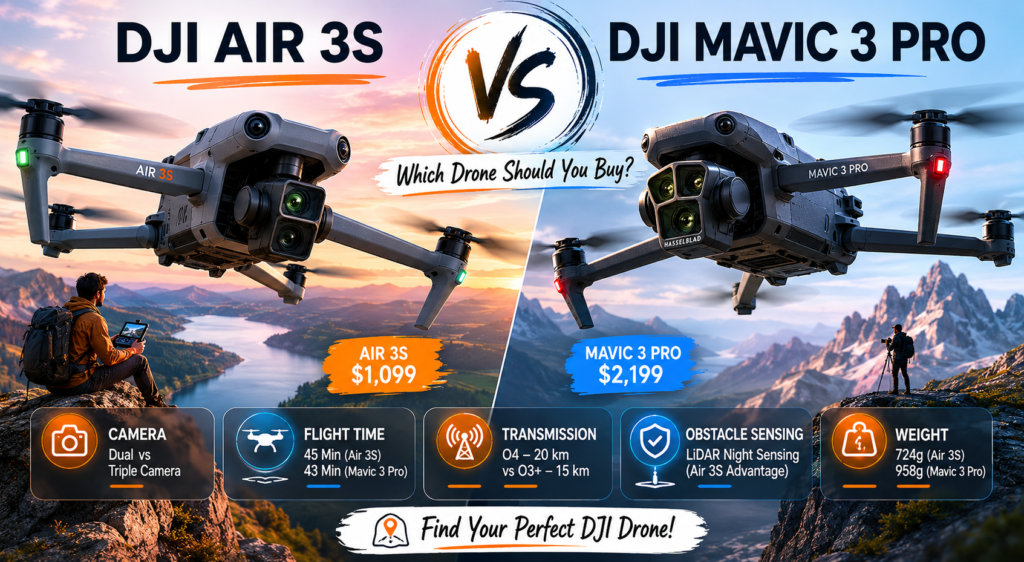
Image Quality Comparison: Is the Air 3S as Good as the Mavic 3 Pro?
The Air 3S Camera System
The Air 3S uses a dual-camera setup. The primary camera is a 1-inch CMOS sensor with a 24mm equivalent focal length, f/1.8 aperture, and 50MP resolution. The second camera is a 1/1.3-inch CMOS medium tele at 70mm equivalent, f/2.8 aperture, and 48MP resolution. Both cameras deliver up to 14 stops of dynamic range an impressive figure at this price point.
For video, the Air 3S supports up to 4K/120fps and 1080p/240fps slow motion in H.265, with a maximum bitrate of 130 Mbps. It also shoots in D-Log M for flexible colour grading in post. One notable addition is the Free Panorama feature on both cameras, which lets you choose a flexible shooting range rather than locking into fixed panorama modes.
The Mavic 3 Pro Camera System
The Mavic 3 Pro brings DJI’s triple-camera system with Hasselblad sensors across all three lenses. The primary camera uses a 4/3-inch CMOS Hasselblad sensor the largest sensor in this comparison shooting 20MP stills at 24mm with a variable aperture of f/2.8 to f/11. The second camera is a 1/1.3-inch Hasselblad sensor at 70mm with 3x optical zoom and 48MP resolution. The third is a 1/2-inch Hasselblad sensor at 166mm, delivering 7x optical zoom and 12MP stills.
All three cameras carry Hasselblad Natural Colour Solution (HNCS), which produces colour science that professionals consistently trust for client deliverables. On the video side, the Mavic 3 Pro supports up to 5.1K/50fps on the primary camera, with 4K/120fps available across all three lenses.
Which Produces Better Footage?
For most creators, the Air 3S produces footage that is genuinely hard to distinguish from the Mavic 3 Pro. The Mavic 3 Pro’s larger sensor and Hasselblad colour science give it an edge in low light and for professional deliverables. Its 7x telephoto lens is the real separator for wildlife, events, or cinematic work where reaching distant subjects without digital zoom matters, there is no substitute.
Air 3S vs Mavic 3 Pro Flight Time and Range: Which Flies Better?
The Air 3S achieves a maximum flight time of 45 minutes, slightly ahead of the Mavic 3 Pro’s 43 minutes. Its ascent and descent speed of 10 m/s in Normal mode is also notably faster. Maximum horizontal speed reaches 21 m/s (up to 27 m/s with a tailwind).
The bigger difference is in transmission. The Air 3S uses DJI’s O4 video transmission system with a 20 km range (FCC). The Mavic 3 Pro uses the older O3+ system with 15 km range. The O4 system also delivers more stable live feeds, including 10-bit video transmission at 1080p/60fps. For anyone flying in dense urban environments or at greater distances, this gap is real and noticeable.
Both drones handle wind of up to 12 m/s. The Mavic 3 Pro weighs 958 grams versus the Air 3S’s 724 grams, so the heavier Mavic tends to hold slightly more stable footage during high-precision manoeuvres in gusty conditions. For the vast majority of flying scenarios, however, both drones exceed most pilots’ demands.
Obstacle Sensing: The Air 3S Takes a Step Forward
Both drones feature omnidirectional obstacle sensing, but the Air 3S goes further. It adds forward-facing LiDAR on top of its binocular vision system, enabling reliable sensing even in low-light and nighttime environments. DJI calls this Nightscape Omnidirectional Obstacle Sensing, and it is a genuine step forward for safe night flying.
The Mavic 3 Pro, released before this technology arrived, relies on omnidirectional binocular vision without LiDAR. In challenging lighting, the Air 3S is simply safer to fly. The Air 3S also includes DJI’s Next-Gen Smart RTH, which memorises flight paths and executes smarter, safer return journeys.
For solo creators flying at night or in complex environments without a spotter, these safety upgrades make the Air 3S a more practical everyday tool.
Travel Portability: Why the Air 3S Beats the Mavic 3 Pro for Backpackers
Every gram matters when you travel. The Air 3S weighs 724 grams and folds to 214 x 100 x 89 mm well-suited to backpacks and carry-on luggage. The Mavic 3 Pro weighs 958 grams, making it 32% heavier.
That gap adds up quickly on long travel days. For creators hiking through national parks, shooting across multiple venues, or backpacking through remote locations, the Air 3S is the more practical companion. For dedicated film crews working from fixed locations or vehicles, the Mavic 3 Pro’s weight is a non-issue and its richer camera system justifies the bulk.
What Each Drone Does Poorly
No drone is perfect. Here is where each one falls short.
DJI Air 3S weaknesses:
- No 7x telephoto option limiting for wildlife and sports
- Smaller primary sensor than the Mavic 3 Pro slightly more noise in very low light
- No Hasselblad branding, which matters to some professional clients
- 42GB internal storage fills quickly with 4K/120fps footage
DJI Mavic 3 Pro weaknesses:
- $1,100 more expensive a significant gap for most buyers
- Heavier and less portable (234g difference)
- Older O3+ transmission shorter range and less stable than O4
- No LiDAR riskier for night flying
- Released in 2023 the Air 3S has measurable tech advantages as a newer model
Intelligent Features and Software
Both drones include ActiveTrack 360° subject tracking, Hyperlapse, QuickShots, and MasterShots. Because the Air 3S is the newer release, it benefits from DJI’s latest AI algorithms. Subject Focusing on the Air 3S which recognises subjects and maintains continuous accurate focus is a meaningful improvement over what the Mavic 3 Pro offers natively.
The Air 3S also supports the DJI 4G Dongle for connectivity in areas with weak O4 signal and works with the DJI RC 2 controller. The Mavic 3 Pro is compatible with the DJI RC and the RC Pro. Professionals who prioritise screen brightness in daylight will prefer the RC Pro a real advantage for high-stakes outdoor shoots.
On storage, the Air 3S includes 42 GB of internal storage. The standard Mavic 3 Pro comes with 8 GB internally, though the Cine version offers 1 TB of internal SSD storage. For pilots shooting in remote locations, the Air 3S’s built-in storage is a practical day-to-day advantage.
Price vs Performance: Is the Mavic 3 Pro Worth $1,100 More?
At $1,099, the Air 3S offers a 1-inch CMOS sensor, 45 minutes of flight time, LiDAR-assisted night sensing, O4 transmission, 4K/120fps video, and 14 stops of dynamic range in a package under 730 grams. The Mavic 3 Pro starts at $2,199 and delivers a Hasselblad triple-camera system, 5.1K video, and proven professional performance.
For content creators, travel vloggers, real estate photographers, and drone enthusiasts who do not specifically need a 7x telephoto or Hasselblad colour science, the Air 3S delivers roughly 90% of the Mavic 3 Pro’s performance at exactly half the price. That is an extraordinary value proposition.
The Air 3S was released in 2024, which means it also benefits from newer technology in transmission, sensing, and software that the 2023 Mavic 3 Pro cannot match on paper. The Mavic 3 Pro remains the right choice for professionals whose work demands full triple-lens versatility. Wildlife photographers who need the 166mm telephoto, cinematographers who rely on Hasselblad colour accuracy, and commercial operators delivering to broadcast standards will find the premium fully justified.
Who Should Buy the DJI Air 3S?
The Air 3S is ideal for travel photographers, solo creators, content entrepreneurs, and advanced hobbyists who want professional-quality imagery without overspending. If you value portability, cutting-edge obstacle sensing, longer flight time, a newer transmission system, and a price that leaves room in your budget for accessories or extra batteries, the Air 3S is your drone. It is one of the best-value drones DJI has ever built.
Who Should Buy the DJI Mavic 3 Pro?
The Mavic 3 Pro is designed for professionals who demand maximum creative versatility. If your work regularly requires multiple focal lengths in a single flight switching from a wide establishing shot to tight telephoto compression the triple-camera system is invaluable. If Hasselblad colour accuracy carries weight with your clients, and your budget stretches comfortably to $2,199 or beyond, the Mavic 3 Pro continues to deliver at the highest level.
Final Verdict
In terms of pure value for money, the DJI Air 3S wins this comparison convincingly. It offers newer technology, superior obstacle sensing, longer flight time, better transmission range, and a lighter frame all for $1,100 less than the Mavic 3 Pro. For the majority of drone pilots, the Air 3S is the smarter purchase.
Value is not one-size-fits-all, though. If triple-camera versatility and Hasselblad quality are essential to your workflow, the Mavic 3 Pro still justifies every penny. Both drones represent the very best of what DJI builds whichever you choose, you are investing in a machine that will genuinely elevate your aerial photography.
Check current pricing and bundles for the Air 3S and the Mavic 3 Pro at the DJI Store.
Visit at https://huntmecoupons.com/store/dji/ for the newest deals and discounts.
