
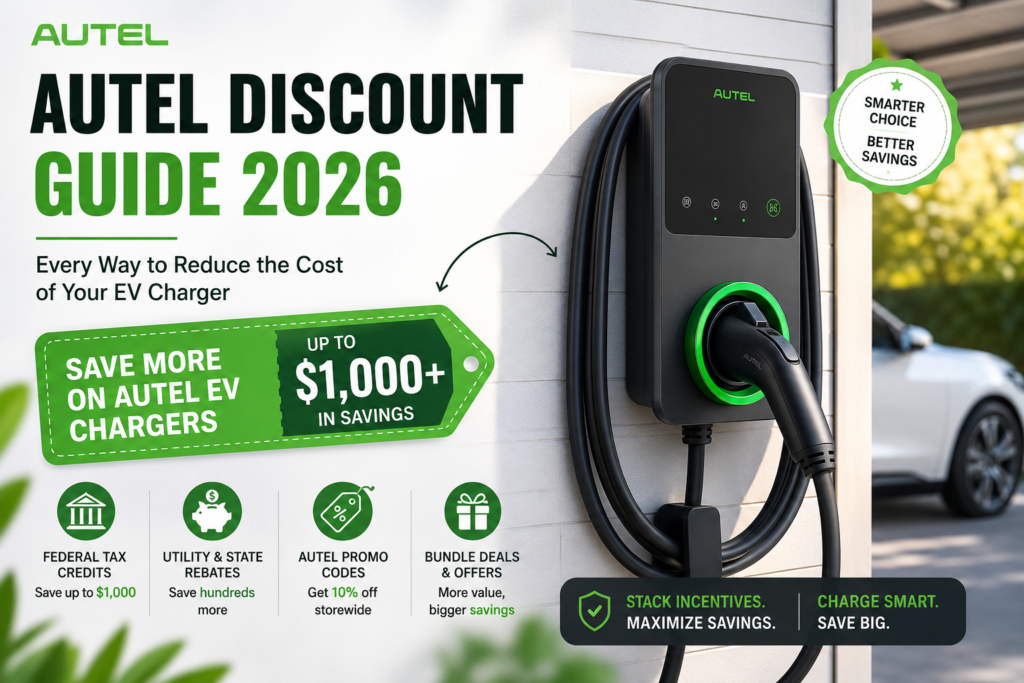
Buying a home EV charger feels straightforward until you start pricing one out, and then the sticker price alone tells only part of the story. Between federal tax credits, utility rebates, manufacturer promo codes, and bundle deals, the real cost of an Autel MaxiCharger can drop by hundreds of dollars once you stack the right savings together. The challenge isn’t finding a single discount; it’s knowing which programs exist, which ones you actually qualify for, and in what order to claim them.
This guide walks through every legitimate way to lower the cost of an Autel EV charger in 2026, from the federal tax credit that’s racing toward a deadline to the everyday promo codes that quietly knock 10% off your cart. Whether you’re outfitting a single-family home, a multi-unit property, or a small business lot, you’ll find a path to savings below.
Why Timing Matters More Than Ever Right Now
Most discount guides start with coupon codes. This one starts with the calendar, because one of the biggest savings opportunities for EV charger buyers is closing fast.
The federal Alternative Fuel Vehicle Refueling Property Credit, commonly known as Section 30C, currently allows homeowners to claim 30% of the cost of a qualifying EV charger and its installation, up to $1,000 per charging port. Businesses can claim up to $100,000 per port, and meeting prevailing wage and apprenticeship requirements unlocks an even higher rate. However, the One Big Beautiful Bill Act, signed into law in 2025, sets this credit to expire on June 30, 2026. After that date, the credit drops to zero unless lawmakers extend it, so anyone hoping to use it needs to purchase, install, and fully activate their charger before the deadline arrives.
Consequently, if you’ve been putting off a charger purchase, this is the moment to move. Because the credit applies to both equipment and labor costs, an Autel MaxiCharger that costs $599 plus a $400 installation could yield up to $300 back at tax time, assuming your property meets the eligibility rules outlined below. That said, the deadline cuts both ways: once it passes, this particular incentive disappears, making early action the difference between a meaningful discount and none at all.
Understanding the 30C Tax Credit Eligibility Rules
Unfortunately, not every homeowner qualifies automatically, so it’s worth checking the fine print before assuming you’ll receive the credit. Since 2023, the 30C credit has applied only to chargers installed in census tracts that the government classifies as either low-income communities or non-urban areas. As a result, your eligibility depends entirely on where your home sits on a federal map, not on your income or the type of vehicle you drive.
To check your status, use the IRS or Department of Energy’s census tract mapping tool, locate your address, and find your eleven-digit GEOID. If your tract appears on the qualifying list, you’re in good shape. If it doesn’t, you won’t be able to claim the residential version of this credit, though state and utility programs may still apply.
Once you’ve confirmed eligibility, the claims process itself is fairly simple. You’ll need to:
- Purchase and install a new, qualifying charger at your primary residence before June 30, 2026
- Keep your purchase receipt, installer invoice, and proof of installation date
- Complete IRS Form 8911 and file it with your federal tax return for the year you placed the charger in service
Because the credit is non-refundable, it can only reduce taxes you actually owe; it won’t generate a refund beyond that. Still, for eligible buyers, it remains one of the largest single discounts available on an EV charger purchase today.
Stacking State and Utility Rebates on Top
Once the federal credit is accounted for, the next layer of savings comes from your state and your local utility company. Indeed, Autel’s own incentives page notes that a rebate or grant is currently available in roughly two-thirds of the United States, funded by electric utilities, municipalities, counties, regional programs, and state agencies. Better yet, you can often combine many of these programs with each other and with the federal credit, since they typically come from entirely separate funding sources.
For example, utility-sponsored rebates for smart Level 2 chargers, like the Autel MaxiCharger AC Elite Home, have ranged from a few hundred dollars up to several thousand dollars depending on the provider and your local energy policy. Programs vary widely from one utility to another, so a homeowner in one state might see a $500 rebate while someone in a neighboring state sees a different figure entirely, or none at all. Therefore, the smartest move is to search using your specific utility’s name alongside terms like “EV charger rebate” before you buy, since you often must meet requirements such as smart-charging capability or program registration before installation rather than after.
Meanwhile, some states layer income tax credits on top of utility rebates, which means a single Autel charger purchase can realistically touch three separate incentive programs: federal, state, and utility. Although tracking all three takes a bit of homework, the cumulative effect can meaningfully offset the upfront cost of going electric at home.
Using Autel Promo Codes and Storewide Discounts
Beyond government incentives, Autel also runs its own promotional pricing directly through its website and authorized retail partners. Storewide promo codes offering roughly 10% off have appeared consistently on Autel’s direct ordering platform, and independent coupon-verification sites that monitor live codes from the community track similar discounts. While the specific code in circulation changes periodically, the discount level has remained fairly steady, which suggests it’s a reliable baseline rather than a rare event.
Additionally, watch for these recurring promo formats:
- Percentage-based storewide codes, typically in the 5% to 10% range, applied at checkout
- Dollar-amount codes, such as $10 off orders above a set minimum spend
- First-order discounts reserved for new customers signing up for the first time
- Accessory-specific codes, such as discounts on charger pedestal mounts or RFID access cards
Because most retailers, including Autel, allow only one promo code per order, it pays to compare a few options before checkout rather than assuming the first code you find is the best one available. Furthermore, some codes exclude clearance items or bundles, so reading the fine print before finalizing your purchase will save you a frustrating “code not applicable” message at the worst possible moment.
Signing Up for the Newsletter Pays Off
If you only do one thing before buying, make it this: sign up for Autel’s email newsletter. New subscribers frequently receive early access to sales, along with email-exclusive offers that don’t appear publicly on the website. Since these promotions often launch ahead of public announcements, subscribers get first pick of inventory and pricing before broader campaigns begin.
Equally important, the newsletter keeps you informed about new product announcements, which matters because Autel routinely launches new charging hardware at major industry events like CES each January. New launches frequently create downstream pricing movement on existing models, as older inventory shifts to clearance to make room for updated versions.
Watching for Seasonal Clearance and Inventory Shifts
Speaking of clearance, end-of-year inventory cycles represent another worthwhile discount window. As Autel prepares to introduce next-generation hardware, retailers and the company’s own storefront tend to mark down remaining stock of current-generation chargers. Although selection narrows during these periods, the units that remain available still carry full manufacturer warranties and ongoing software support, so buyers aren’t sacrificing reliability to save money.
Similarly, keep an eye on major retail sales events throughout the year, including Amazon’s Big Spring Sale and other recurring promotional windows. Third-party retailers carrying Autel’s MaxiCharger lineup, including the brand’s official Amazon storefront, have repeatedly discounted popular models like the AC Pro 80A and AC Elite Home 50A during these events, sometimes bringing prices several hundred dollars below the standard list price. Because pricing on these platforms fluctuates based on inventory and promotional calendars rather than a fixed schedule, checking back periodically tends to pay off more than waiting for one specific date.
Comparing Models Before You Commit to a Price
It’s also worth noting that the cheapest charger isn’t always the cheapest choice. Autel’s residential lineup spans multiple amperage tiers, from 40A units built around NEMA 6-50 or NEMA 14-50 outlets to the 50A hardwired AC Elite Home and the more powerful 80A AC Pro. A lower-amperage model carries a lower sticker price, yet it may charge your vehicle more slowly, which could matter if you’re working with a tight overnight charging window.
Consequently, before chasing the lowest number on the page, consider your vehicle’s onboard charging capacity, your home’s electrical panel capacity, and how quickly you actually need a full charge. A slightly more expensive unit that matches your real-world needs often delivers better long-term value than the cheapest option on the shelf, even after factoring in every available discount.
Don’t Overlook Installation Cost Savings
Equipment discounts are only half of the total cost equation, since installation labor frequently rivals or exceeds the price of the charger itself. Fortunately, the same 30C federal credit and many utility rebates apply to qualifying installation expenses, not just the hardware, which means proper documentation of labor costs can meaningfully increase your total credit or rebate amount.
To capture this value, request an itemized invoice from your electrician that separates the charger cost from labor, panel upgrades, conduit, and wiring. Because some incentive programs calculate the credit based on combined equipment-and-installation costs, an itemized invoice ensures you claim the full amount you’re entitled to rather than leaving money on the table due to incomplete paperwork.
Bringing It All Together: A Simple Savings Checklist
Pulling every strategy together, here’s a practical order of operations for stacking your discounts:
- Check your census tract eligibility for the federal 30C credit before June 30, 2026, since this single incentive can be worth up to $1,000.
- Search your utility provider’s rebate program, since two-thirds of the country currently has some form of EV charger incentive available.
- Look up your state’s tax credit programs, since you can often combine them with both federal and utility incentives.
- Sign up for Autel’s newsletter to unlock early-access pricing and subscriber-only offers.
- Compare current promo codes before checkout, prioritizing the highest available discount that fits your order.
- Watch for clearance and seasonal retail sales if you’re flexible on timing and model year.
- Keep itemized receipts for both equipment and installation, since thorough documentation maximizes every credit and rebate you claim.
Ultimately, the most effective discount isn’t any single coupon or credit; it’s the combination of all of them, applied in the right sequence. Government incentives, utility rebates, and manufacturer promotions work independently by design, which means a buyer who takes the time to research each layer can often save significantly more than someone who simply waits for a single sale event.
Final Thoughts
Reducing the cost of an Autel EV charger comes down to research and timing rather than luck. The federal tax credit alone is worth investigating immediately, given its approaching deadline, while utility and state programs offer savings that persist well beyond any single calendar date. Layer in Autel’s own promotional codes, newsletter perks, and seasonal clearance pricing, and the final price you pay can look very different from the number on the product page.
Before making a final decision, take a few minutes to check your eligibility for each program outlined above. A little upfront homework can turn a standard EV charger purchase into a considerably smarter investment, both for your wallet and for your home’s long-term charging setup.
For more deals & discounts visit https://huntmecoupons.com/store/autel/.
