
Every EV owner asks the same question eventually. You are on a road trip. The battery is at 12%. A DC fast charger appears and you plug in. Twenty minutes later you are back on the road with 80% charge. But a worry sits in the back of your mind: is this slowly destroying your battery?
It is a fair concern. The battery is the most expensive part of your EV. It affects your car’s range, its resale value, and how much you enjoy owning it long term. So in 2026, with more real data than ever before, it is worth looking at exactly what fast charging does and what the evidence actually says.
What Fast Charging Does to a Battery
To understand the impact, it helps to know how fast charging works at a basic level.
A Level 2 home charger sends power into your car slowly and steadily. Most home chargers deliver between 6kW and 19.2kW. That gradual flow produces little heat and puts low stress on the battery cells.
DC fast charging works differently. It pushes power straight into the battery pack at much higher levels — typically between 50kW and 350kW at modern US stations. The car’s Battery Management System controls this process. But the higher current still creates more heat than Level 2 charging. Heat is the main way fast charging affects battery health over time.
When cells heat up during high-current charging, the chemical reactions inside them speed up. This can wear out the battery faster than slow charging does. That is the basic science. However, what the 2026 data shows is that the real-world impact is more measured than the headlines suggest.
What the 2026 Data Actually Shows
The most important study on this topic right now is Geotab’s 2026 battery health analysis. It tracked over 22,700 real EVs across 21 different models. The findings are specific and worth knowing.
The Key Numbers from Geotab
According to Geotab’s data, the average EV battery loses around 2.3% of its capacity per year. EVs that used high-power chargers above 100kW for more than 12% of all sessions saw around 2.5% annual degradation. By contrast, drivers who relied mainly on Level 2 home charging saw closer to 1.5% per year.
For modern EVs with liquid-cooled battery packs, occasional fast charging adds very little extra wear compared with home charging. The total difference between heavy DC fast charging and mostly Level 2 use is often only 2 to 3% of battery capacity over several years. That is real, but it is not a disaster for most drivers.
What Recurrent Found with Tesla Vehicles
A separate study by Recurrent looked at over 12,500 Tesla vehicles in the US. It found no big difference in battery capacity loss between cars that fast-charged more than 90% of the time and those that did so less than 10% of the time. Tesla uses mature battery software that actively protects cells during fast charging. This result shows that software matters nearly as much as hardware when it comes to battery health.
The clearest takeaway from all this data: fast charging is not the battery killer it is often made out to be. However, how you use it still matters.
The Conditions That Make Fast Charging More Harmful
The data shows that fast charging on its own is not the main problem. The risk rises sharply when it combines with certain habits.
Charging at a High State of Charge
Above 80%, the charging curve slows down significantly. You end up sitting at a paid public station for little gain. At the same time, high voltage above 80% puts stress on the battery in NMC and NCA chemistry vehicles. Charging from 10% to 80% is a very different ask than charging from 80% to 100%. The upper portion of the charge range is where stress builds up most.
Charging in Extreme Heat
Temperature makes fast charging harder on the battery. Hot climates add about 0.4% extra annual degradation compared to cooler regions. Fast charging a battery that is already hot from a long summer drive, then parking it in the sun at full charge, creates the worst possible conditions for battery health.
Using Very High Power Levels Every Day
Battery packs wear faster when charged regularly above 100kW. Level 2 and lower-power fast chargers produced around half the degradation rate by comparison. Using a 150kW or 350kW charger on a road trip now and then is very different from using one as your daily charging routine.
Battery Chemistry Makes a Big Difference
Not all EV batteries react to fast charging the same way. LFP chemistry has the strongest track record for drivers who use fast chargers often. It shows almost no extra wear even under heavy fast-charging use. LFP also lets you charge to 100% regularly without the stress that harms NMC and NCA cells. If your EV uses LFP as many standard-range Tesla Model 3 and BYD vehicles do — the concern about fast charging is much smaller.
What the Data Says About Sitting at 100%
Fast charging gets most of the attention in this topic. However, sitting at 100% for long periods causes similar harm and gets far less coverage.
The damage happens when your car sits at 100% or 0% for days at a time. Charging to 100% the night before a long trip is completely fine. The problem is not reaching full charge it is leaving it there for hours or days on end. Most experts and studies recommend keeping daily charge limits between 70% and 80%. Charge to 100% when you need the range, but set it back down for normal daily use.
Keeping the battery in the middle range of roughly 20 to 80% is easier on the chemistry. Level 2 home charging overnight is ideal for this. The car charges slowly while you sleep. The pack stays cool. And you start each morning in the sweet spot for battery health.
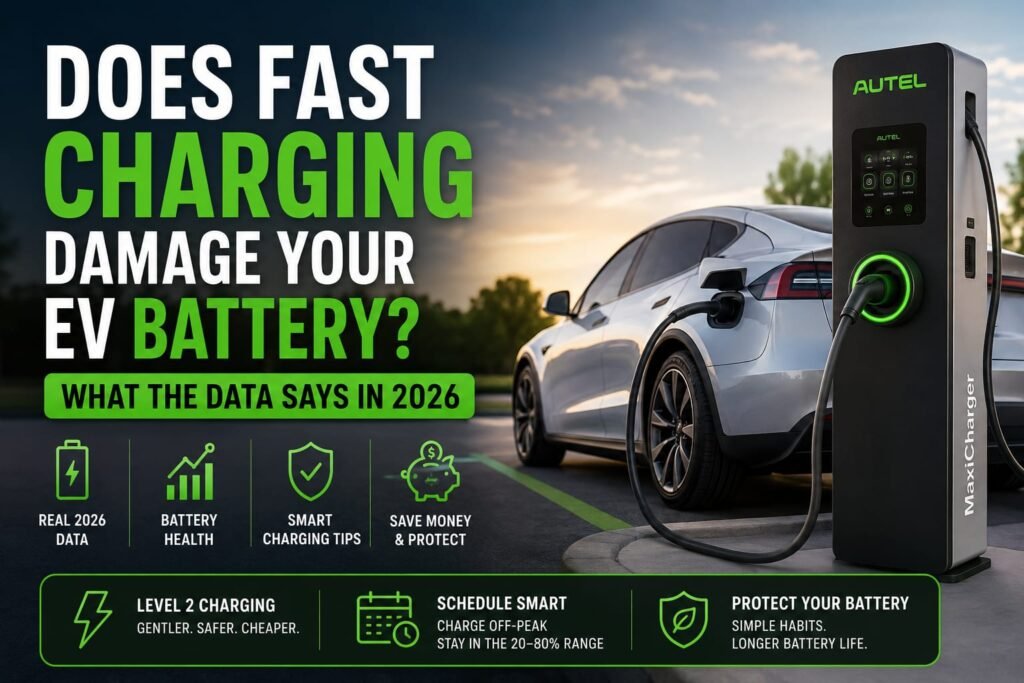
Why Home Level 2 Charging Is the Better Daily Choice
All the data above points to the same conclusion. Level 2 home charging is the gentlest way to charge your EV day to day. Fast charging works best when you need speed on road trips and long journeys.
The Cost Difference Is Also Significant
DC fast charging in the US costs between $0.35 and $0.65 per kWh. Home Level 2 charging at the US average of $0.13 per kWh costs around $5.85 for the same 45kWh session. That same session at a fast charger can cost up to $29.25. Over months and years, that gap adds up to hundreds of dollars annually. The battery health benefit of home charging comes with a lower electricity bill on top.
Where the Autel MaxiCharger Comes In
This is where an Autel Energy home charger makes a practical difference. The Autel MaxiCharger range delivers Level 2 charging at up to 12kW for 50A models and up to 19.2kW for the 80A model. Both cover the full overnight charging needs of every EV and plug-in hybrid on the US market today. The chargers are Energy Star certified, built for indoor and outdoor use, and connect to the free Autel Charge app for full smart control.
How the Autel Charge App Helps You Charge Smart
Every study on this topic recommends the same habits. Charge during off-peak hours. Avoid sitting at 100% for too long. Keep sessions within the 20 to 80% range for daily use. The Autel Charge app makes all three straightforward.
Scheduling and Stop Times
Through the app’s scheduling tool, you set your charger to start and stop at specific times. For example, begin at 11pm and stop at 6am. The battery tops up overnight. It does not sit at full charge for hours before your morning drive. This simple habit alone reduces daily stress on the cells.
Energy Tracking and Cost Monitoring
The app also shows real-time power use, energy cost, and session length. You can set your local electricity rate and track what each charge actually costs. For drivers on time-of-use pricing — where rates drop late at night — the scheduling tool can save between $100 and $300 per year on electricity bills alone.
Adjustable Output Power
The Autel Charge app lets you adjust the output level of your charger directly from your phone. This gives you control over how fast the car charges on any given night. If you only need a small top-up, you can lower the power and reduce heat output during the session.
The app is free to download on iOS and Android. It carries no subscription fees and works with the full Autel MaxiCharger range.
The Simple Rules for Battery Health in 2026
The data makes the practical advice clear. Here is what it actually recommends.
Use Level 2 home charging as your daily default. It is gentler on the cells, much cheaper per kWh, and keeps the battery in the range that is best for long-term health. Use fast charging on road trips and when you truly need speed. Treat it as a tool for specific situations rather than a daily habit.
Keep your daily charge limit at 70 to 80%. Set a stop time in the Autel Charge app to enforce it. Charge to 100% the night before a long drive. But do not leave the car sitting at full charge for days on end.
Avoid fast charging a hot battery. If you have been driving in summer heat, a short rest before plugging into a fast charger lets the thermal system cool the pack down first. This reduces stress on the cells during the session.
Know your battery chemistry. LFP users have more freedom. You can charge to 100% often and use fast chargers more freely with little long-term effect. NMC and NCA users benefit most from the habits above.
Frequently Asked Questions
Does fast charging damage your EV battery? In moderate use, the impact is small. Geotab’s 2026 study of 22,700 EVs found that drivers using high-power DC fast chargers for more than 12% of sessions saw around 2.5% annual degradation. Drivers using mostly Level 2 saw around 1.5%. The gap is real but manageable for most drivers.
Is it safe to fast charge every day? The data suggests it is not the best habit for long-term battery health. Frequent high-power DC fast charging above 100kW speeds up degradation over time. Level 2 home charging is the better daily choice. Fast charging is best kept for road trips and urgent situations.
What is the best state of charge for daily use? Most experts and studies recommend keeping the battery between 20% and 80% for everyday driving. Charging to 100% for long trips is fine. The issue is leaving the battery at full charge for extended periods when you do not need the range.
Does battery chemistry affect how fast charging harms the battery? Yes, significantly. LFP batteries show almost no extra wear from heavy fast charging. NMC and NCA batteries are more sensitive, especially at high charge levels and in hot conditions.
How does an Autel home charger help protect battery health? Level 2 charging runs at lower power and produces less heat than DC fast charging. The free Autel Charge app also lets you schedule sessions, set stop times, and track energy use. Together, these tools make the battery-friendly charging habits easy to follow every day.
Where can I buy an Autel Energy home charger? Directly from the official store at store.autelenergy.com. Use coupon codes SAVE10 or HELLO10 for 10% off sitewide. Also check the rebate finder at store.autelenergy.com/pages/local-incentives for federal and state savings that may apply in your area.
Final Thoughts
The 2026 data gives a clear answer. Fast charging does affect battery health. But for most drivers, the impact is small, manageable, and easy to reduce with simple habits. The biggest risks are not fast charging itself. They are charging to very high levels every day, parking a full battery in heat, and using very high-power chargers as a routine rather than an occasional tool.
For everyday charging, a reliable Level 2 home charger does the job better, more cheaply, and more gently than any public station. The Autel MaxiCharger range, paired with the free Autel Charge app, gives you everything you need to charge smart every night.
Browse the full Autel Energy range at the Autel Energy Official Store and use code SAVE10 or HELLO10 for 10% off your order. Visit HuntMeCoupons for the latest verified coupon codes before you checkout.Visit our site https://huntmecoupons.com/store/autel/ to avail more amazing deals and discounts.
