
A new academic year brings a familiar kind of pressure. Reading lists land in your inbox before you have even unpacked. Then essay deadlines appear on the calendar before the first lecture ends. On top of that, seminar reading turns out to be three times longer than you expected. Ultimately, you need sources that are reliable, relevant, and ideally free or covered by your student subscription.
That is where Brill steps in. And the good news? Many of the best Brill resources cost you nothing extra beyond your student login.
Brill is one of the world’s leading publishers in the humanities, social sciences, and international law. Founded in Leiden, the Netherlands, in 1683, it merged with De Gruyter in 2024 to form De Gruyter Brill. Today, this publishing powerhouse produces more than 3,500 books and 800 journals every year. Brill covers the full spectrum of the humanities and social sciences from African Studies and Classical Studies through to International Law, Life Sciences, and everything in between. Chances are, your subject sits comfortably in that catalogue. So this back-to-school season, here is exactly what Brill offers you and how to get it without spending a fortune.
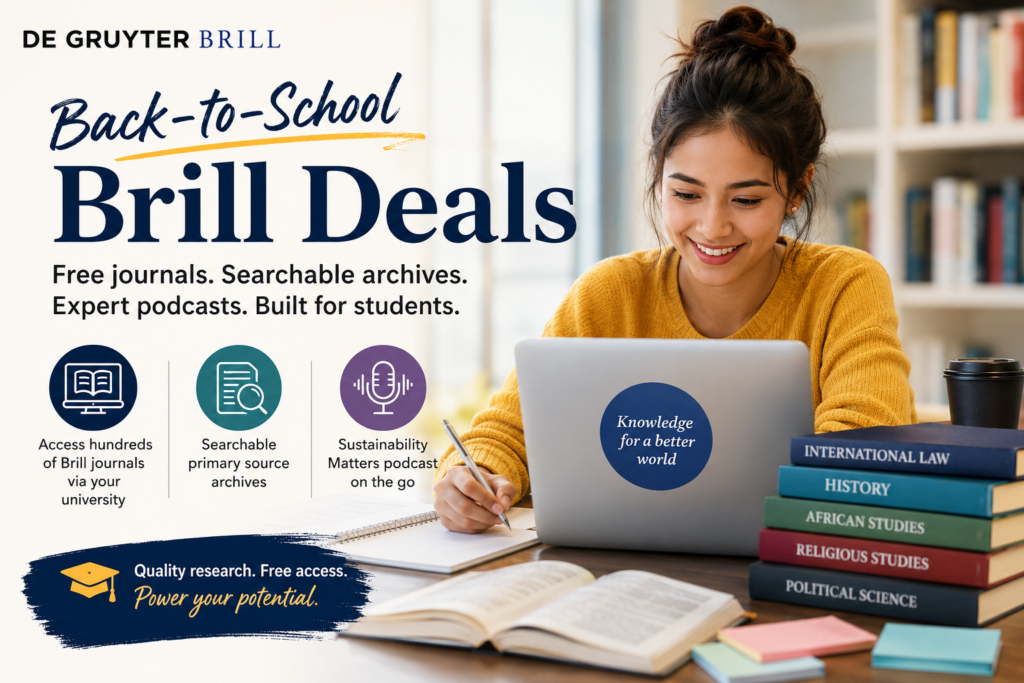
Deal 01: Your University Already Pays for This Are You Using It?
Here is the deal most students overlook entirely. Your institution almost certainly subscribes to a range of Brill journals and databases. That means you already have access to hundreds of peer-reviewed journals and specialist research collections at zero personal cost. You simply need to know where to look.
How to unlock your institutional access
Start with your institution’s library database portal and search for Brill. If you are unsure which titles your library covers, speak to your subject librarian directly. They can walk you through which Brill journals and databases fall within your subscription. More importantly, they can often arrange trial access to collections your library does not yet license. Nevertheless, many students never think to ask and consequently miss out on resources that would genuinely improve their research.
Brill’s journal catalogue spans 800 titles across every major humanities and social science discipline. Each journal brings together original research from leading scholars worldwide. Furthermore, all are reviewed by expert editorial boards and published to the highest academic standards. As a result, citing peer-reviewed Brill journals in your essays demonstrates the kind of scholarly rigour that tutors and markers notice and reward.
A recent article worth reading
A strong example is Middle East Law and Governance, one of Brill’s flagship journals in political and legal studies. In Volume 16, Issue 2 (2024), Associate Professor Tamirace Fakhoury of the Fletcher School of Law and Diplomacy at Tufts University, together with co-author Miriam Aitken, published Rethinking Power-Sharing in Post-War Lebanon: The Case for a Pluralist and Multi-Level Research Agenda. The article challenges established consociational theory the dominant framework for studying power-sharing in divided societies. Instead, it argues for a more interdisciplinary approach. Specifically, this draws on political economy, social movement studies, and transnational citizenship research.
What makes this article particularly valuable for students is not just its content, but what it models. It shows you how to engage critically with a dominant theoretical framework. It also demonstrates how to draw productively on multiple disciplines, and how to situate a specific national case study within a broader global context. So if you study politics, international relations, Middle Eastern studies, sociology, or law, this article will sharpen both your thinking and your academic writing.
The article also connects to live political questions. For instance, Lebanon elected a new president in January 2025 after a two-year political vacuum. The frameworks explored in Fakhoury and Aitken’s research help explain why that gap existed and what genuine reform might look like. That kind of real-world relevance is exactly what good academic research delivers and Brill journals consistently deliver it.
So before you spend a penny on academic resources this semester, log in to your library portal and see what Brill titles you already have. The answer might surprise you.
Deal 02: Searchable Primary Source Archives Find That Quote in Seconds
One of the biggest time-drains in student research is hunting for primary sources. You know broadly what you need. However, actually locating the right document let alone reading and citing it is a different challenge. Traditional archives require physical visits, advance booking, and hours of manual searching through uncatalogued materials. Clearly, that model does not fit student life, particularly when deadlines are close.
Fortunately, Brill’s digitised archive collections change this entirely.
Warfare in China 1839–1945: a case study in accessibility
Take Warfare in China 1839–1945: British Perspectives, published by Brill in 2025 in association with The National Archives, London. Academic advisors Dr Matthew Heaslip of the University of Portsmouth and Associate Professor Chi Man Kwong of Hong Kong Baptist University guided the collection. It gives you direct, searchable access to over 120,000 digitized images of primary source documents. These cover defining moments in Chinese and British imperial history the Opium Wars, the Taiping Rebellion, the Boxer Rising, and the Second Sino-Japanese War, among others.
Before this collection launched, these documents sat in archive rooms at Kew. Previously, they could only be consulted in person by researchers with a reader’s ticket. Now, however, a student in Edinburgh, Lagos, or Seoul can access the same materials as a researcher visiting The National Archives. That shift in accessibility is genuinely significant. Indeed, it reflects a broader commitment at Brill to making primary source research available to students and scholars everywhere.
Search smarter, not harder
What makes the collection especially powerful is the search functionality. Brill applies optical character recognition OCR to both printed and handwritten documents. Rather than manually flipping through hundreds of pages, you simply type a name, place, event, or keyword into the search bar. Every document containing that term surfaces immediately. Therefore, for a history student writing on British imperial strategy in East Asia, or a politics student tracing the roots of modern Chinese foreign policy, that precision saves hours of research time.
In addition, the collection includes introductory essays and editorial context written to guide readers through the materials. Even if you have never worked with primary sources before, you get the scholarly framework you need to interpret what you are reading and understand why it matters.
An interconnected research ecosystem
The collection also sits alongside a broader cluster of related Brill resources. These include the North China Herald Online, Translations of the Peking Gazette Online, British Intelligence Files on China and the Boxer Rising, c. 1880–1930, British Intelligence Files on the Chinese in Tibet (c. 1900–1950), and U.S. Intelligence on Asia, 1945–1991. Together, these form an interconnected research ecosystem. Once you start exploring one, the others open up connected lines of inquiry you had not anticipated.
In short, this is student research tools at their best not a single archive, but a network of primary sources that talk to each other across time periods and perspectives.
Multimodal Learning: From Archives to Audio
Serious academic research happens at your desk. But intellectual development happens everywhere including your commute, your morning run, and the twenty minutes between lectures when you do not have enough time to open a book. Brill understands this. That is why De Gruyter Brill relaunched its long-running podcast in May 2025 under the name Sustainability Matters.
Originally launched in early 2020 as Humanities Matter, the podcast has consistently brought expert voices into conversation with pressing global questions. Over the years, it has covered topics ranging from climate change and religion to pride and fashion. Under its refreshed identity, Sustainability Matters now focuses on sustainability in scholarly communications and beyond. Specifically, episodes explore diversity and inclusion in academia, the global accessibility of research, research ethics, transdisciplinarity, and the fight against misinformation.
Several recent episodes are directly relevant to university life. Episode 1 features Nimisha Barton discussing tokenism and what genuine diversity in higher education actually looks like. Then Episode 2 brings together Siri Granum Carson and Matthias Kaiser to explore transdisciplinarity and the future of knowledge. They ask how different academic disciplines can work more productively across their traditional boundaries. For students who study at the intersection of multiple fields history and politics, literature and sociology, law and philosophy this conversation speaks directly to how your studies are structured and why.
Meanwhile, Episode 4, with author and scholar Naomi S. Baron, tackles originality in the age of generative AI. If you are navigating questions about how and when to use AI tools in your academic work, this episode offers nuanced, research-backed perspective. Rather than blanket condemnation or uncritical enthusiasm, Baron brings genuine scholarly thinking to a question that affects every student today. Similarly, Episode 5, with Christine Ivanov and Maria B. Lange, examines how gender-fair language shapes research literature. It is relevant not just for linguistics students, but for anyone thinking carefully about how academic writing evolves.
Each episode connects you to real scholarly thinking on issues that affect your life and your studies. Furthermore, many podcast guests are also Brill authors. As a result, listening to an episode often leads you directly to a book or journal article worth citing in your next essay. Best of all, Sustainability Matters is completely free and available now on Spotify, Apple Podcasts, and Amazon Music.
→ Listen to Sustainability Matters on Spotify, Apple Podcasts, or Amazon Music
Deal 03: Free Content Through Brill’s Open Access Programme
Brill’s commitment to open access is one of the most student-friendly aspects of the publisher’s offering and one of the least talked-about. A growing proportion of Brill’s journal articles and book chapters are freely available online. No subscription is required and no paywall stands in the way. This matters enormously for students at institutions with limited library budgets. It also helps international students whose home institutions may not subscribe to the full Brill catalogue.
Brill actively works to expand its open access publishing across books, journals, and digital collections. The underlying philosophy is consistent with everything Brill does: quality research should reach as wide an audience as possible. A historian in Nairobi should have access to the same primary sources as one in London. Equally, a politics student in Manila should be able to read the same peer-reviewed analysis as one in Amsterdam. Open access publishing moves the academic world meaningfully closer to that goal.
To find Brill’s open access content, visit brill.com and filter by open access when browsing journals or books. You can also sign up for Brill’s academic newsletter. It regularly highlights new open access releases alongside new publications in your subject area. Signing up takes under a minute. As a result, you will hear about new affordable academic journal content as soon as it becomes available including back-to-school resources and seasonal highlights across all of Brill’s subject areas.
How to Get the Most Out of Brill This Semester
Getting started with Brill as a student comes down to four practical steps. Each takes very little time but pays off throughout the academic year.
Step 1: Check your institutional access
First, log in to your institution’s library database portal and search for Brill. Note which journals, databases, and digital collections your subscription already covers.
Step 2: Talk to your subject librarian
Next, ask about Brill collections that relate to your modules. Librarians know things that are not always obvious from the catalogue. They can also advocate for new subscriptions on your behalf.
Step 3: Browse open access content
Then visit brill.com for anything your institution does not already cover. Filter by open access to find free peer-reviewed content in your subject area.
Step 4: Subscribe to the podcast
Finally, add Sustainability Matters to your podcast app. It gives you something genuinely worthwhile for the commute or the study break.
Brill’s catalogue spans every major discipline in the humanities and social sciences. Whether you study history, philosophy, linguistics, religious studies, African studies, biblical studies, media studies, musicology, or international law there is Brill content relevant to your coursework and your intellectual development. Moreover, much of it is either freely available or already covered by your student subscription.
University is demanding. The reading is relentless, the deadlines are real, and the quality of your sources shapes the quality of your work. Nevertheless, Brill gives you the scholarly tools to make this your strongest academic year yet. These tools are built on over three centuries of publishing excellence and delivered in formats that fit how students actually study today.
Your education is the most important investment you will make. So make sure the resources behind it match the ambition you bring to it.
→ Browse Brill’s full catalogue at brill.com
Visit https://huntmecoupons.com/store/brill/ for more offers deals.
