
Academic publishing has never been cost effective and for scholars in the humanities, social sciences, international law, and related disciplines, Brill sits at the center of much of that financial pressure. As part of De Gruyter Brill since their 2024 merger, this publisher now releases over 3,500 books and 800 journals annually, spanning Middle East and Islamic Studies, Asian Studies, Classical Studies, Biblical and Religious Studies, Language and Linguistics, History, Education, Biology, Human Rights, and International Law. That is an enormous body of indispensable scholarship, and accessing or contributing to it can feel financially out of reach.
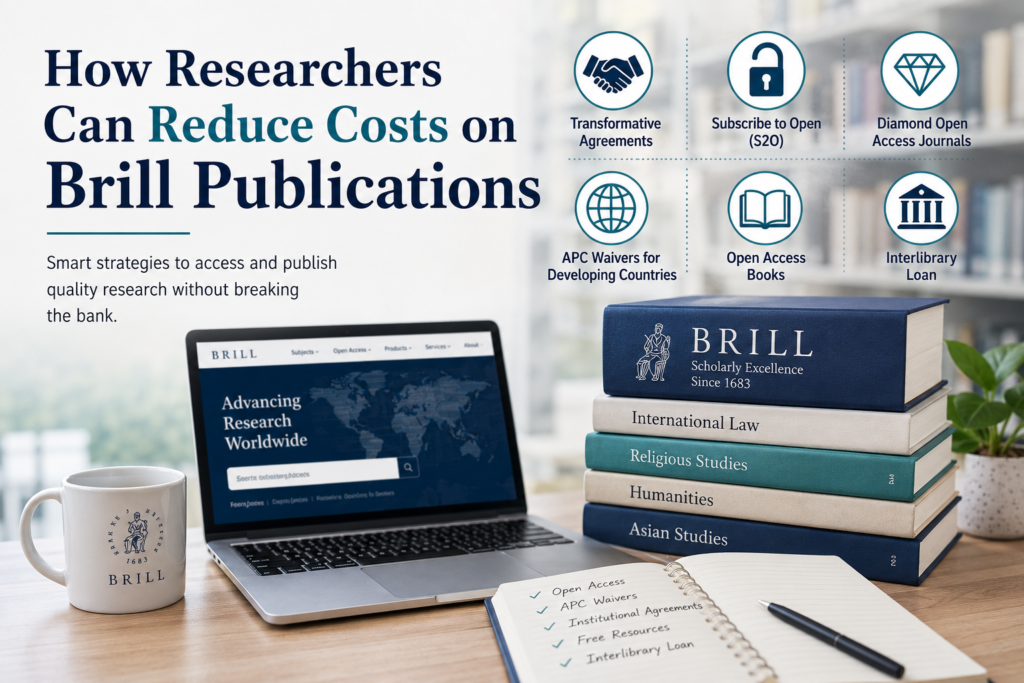
Fortunately, Brill has built a wide range of cost-reduction pathways for both readers and authors. Whether you are affiliated with a university, working as an independent scholar, or based in a lower-income country, at least one of the strategies below applies to your situation. This guide covers every verified route, so you can access and publish Brill content while spending as little as possible, or nothing at all.
1. Leverage Your Institution’s Transformative Agreement
The single most powerful cost-reduction tool for affiliated researchers is a Transformative Agreement also called a Read and Publish deal. Brill has established institutional open access agreements with consortia and leading university libraries across the globe, giving affiliated authors both reading access to the full journal portfolio and the ability to publish open access at no personal cost.
Critically, all of these institutional deals are uncapped. There is no annual limit on the number of articles a researcher at a participating institution can publish open access. When your institution holds such an arrangement, submitting with your institutional email address is enough Brill’s system identifies you automatically and applies the full APC waiver, publishing your work under a CC-BY license at zero cost to you.
Coverage has expanded substantially in recent years. In 2024, Brill added Zentralbibliothek Zürich, Freie Universität Berlin, Paris Lodron University of Salzburg, the MALMAD Consortium in Israel, and the EISZ Consortium in Hungary, among others. Then in 2025, thirteen additional agreements were signed with institutions and consortia globally including the Norwegian consortium SIKT, the JULAC consortium in Hong Kong, and several US universities.
What you should do: Check your library’s open access publishing page, or email your librarian directly, to confirm whether a Brill agreement is active. If your institution is not yet covered, ask your librarian about joining your subscription renewals can directly support Brill’s S2O transition (see below), making this a worthwhile conversation.
2. Publish in Diamond Open Access Journals
Diamond open access is the most equitable publishing model available: no costs for authors, no paywalls for readers. Brill’s Diamond journals also called sponsored journals are funded entirely by a sponsoring institution or learned society, so neither side of the transaction pays anything. Authors retain copyright under a Creative Commons license, and their work reaches the widest possible audience from the moment of publication.
Brill’s portfolio currently includes 39 Diamond journals, covering a range of subjects within the humanities and social sciences. For any researcher whose field overlaps with one of these titles, this is the ideal route. Your scholarship travels further, your institution pays nothing, and you pay nothing.
What you should do: Browse the Brill journal catalog and filter for Diamond or fully sponsored titles in your subject area. When a Diamond journal’s scope aligns with your research, prioritize it the cost equation simply does not get better than this.
3. Explore the Subscribe to Open (S2O) Model
Not every researcher works at an institution covered by a Brill deal. Even so, another cost-free route is steadily growing: Subscribe to Open, or S2O.
S2O transitions subscription journals to open access one year at a time, without author-facing fees. The mechanism is straightforward when enough institutions renew their subscriptions to a given journal, that year’s content flips to fully open access, freely readable by anyone, with no charges for authors. Libraries keep what they already pay for; authors and readers gain free access as a result.
In 2025, Brill transitioned an additional 58 journals to open access through this model. Researchers who submit to those journals face no publishing costs regardless of institutional affiliation and the content they produce becomes immediately available to the global scholarly community.
What you should do: Before selecting a Brill journal for submission, verify whether it participates in S2O. Brill’s journal pages and the publisher’s open access portal list this status. Choosing an S2O journal means zero APC exposure by default.
4. Tap Into EIFL Agreements for Researchers in Lower-Income Countries
Brill’s commitment to equitable access extends well beyond wealthy research-intensive universities. Through its partnership with EIFL (Electronic Information for Libraries), Brill has negotiated waived or discounted Article Processing Charges for authors in a wide range of EIFL partner countries.
Corresponding authors from countries including Ethiopia, Ghana, Kenya, Nepal, Myanmar, Sudan, Tanzania, Uganda, Zambia, and Zimbabwe receive a complete APC waiver when publishing in Brill’s fully open access or hybrid journals. Authors from a second group of countries including Albania, Armenia, Azerbaijan, Georgia, Palestine, Thailand, and Uzbekistan, among others receive a 60% discount on APCs.
The rationale is simple: scholarship is global, but research funding is not distributed equally. By removing the financial barrier for researchers in lower-income countries, Brill ensures that geography and institutional wealth do not decide whose work enters the scholarly conversation.
What you should do: Confirm your country’s eligibility on the EIFL website at eifl.net, which maintains the current list of partner countries and covered journals. When submitting, provide your institutional affiliation so Brill can apply the waiver or discount correctly.
5. Apply for an Individual Hardship Waiver
Here is a pathway many researchers overlook entirely: individual hardship waivers. Independent scholars, unfunded researchers, and authors who fall through the gaps of institutional and geographic programs can apply directly to Brill for an APC waiver on the basis of personal financial circumstance.
This option is especially important for independent researchers, since most transformative agreements require institutional affiliation. If you have no university affiliation and your country is not covered by EIFL, a hardship waiver application is your primary route to zero-cost open access publishing. Brill evaluates these requests on a case-by-case basis, so a clear explanation of your circumstances and funding situation strengthens the application considerably.
What you should do: Contact the editorial office of the specific Brill journal you are targeting and explain your situation in a concise, factual message. Requesting a waiver at the point of acceptance once your article has been peer-reviewed and accepted is the standard approach. Do not assume rejection; many publishers handle more of these requests than they publicize.
6. Access Free Content Through Brill’s Open Access Book Collections
Beyond journal articles, Brill ranks among the largest open access book publishers in the humanities and social sciences. As of 2024, the publisher had released over 5,000 open access book titles in total, with more than 500 new open access books added in that year alone.
A large portion of these titles are freely available through established platforms. JSTOR hosts Brill’s open access ebook collection and makes it highly discoverable for researchers worldwide. OAPEN (Open Access Publishing in European Networks) and the Directory of Open Access Books (DOAB) also index significant portions of Brill’s open output. Additionally, Brill participates in the Knowledge Unlatched program, a library consortium model that collectively funds the open access release of scholarly books. Through Knowledge Unlatched, Brill has released titles across Political Science, History, Philosophy, Sociology, Classics, Religious Studies, and other disciplines all carrying Creative Commons licenses and freely available through multiple repositories.
What you should do: Before purchasing any Brill book, search for it on JSTOR, OAPEN, DOAB, and the Knowledge Unlatched catalog. A growing proportion of Brill’s book output is openly accessible through these platforms, and searching takes only a few minutes.
7. Use Interlibrary Loan for Paywalled Content
For content that falls outside both open access channels and your institution’s subscriptions, interlibrary loan (ILL) remains one of the most reliable and most overlooked tools in a researcher’s cost-reduction toolkit. Through ILL, your library requests a copy of a specific journal article or book chapter from another institution that holds access typically at no charge to you.
Most university and college libraries offer this service, and fulfillment often takes just a few business days. Planning ahead removes the only real limitation of ILL it is not instant. For virtually any Brill content your home institution does not subscribe to, this route delivers access for free.
What you should do: Set up an ILL account with your library if you have not already done so. For Brill journals you access regularly, consider asking your librarian to add them to the institution’s subscription list especially those in the S2O program, where your library’s renewal directly accelerates open access for the wider community.
8. Use Green Open Access Self-Archiving to Find and Share Work
Even when a Brill article sits behind a paywall, a freely accessible version may already exist legally through green open access. Many Brill authors self-archive their accepted manuscripts in institutional repositories, subject repositories such as PhilArchive or SSRN, or on personal academic profiles.
Before paying for access to any Brill article, run a parallel search on Google Scholar. It consistently surfaces legally available author versions alongside the paywalled publisher version. Checking the author’s institutional page or Academia.edu profile often yields the same result.
If you are preparing to publish, check your target journal’s self-archiving policy before submission. The tool Sherpa/RoMEO (sherpa.ac.uk/romeo) indexes self-archiving policies by publisher and journal, so you can confirm exactly which version you are permitted to deposit, and where. Knowing your rights before signing a publishing agreement costs nothing and ensures your work remains as accessible as possible.
What you should do: Search Google Scholar for any Brill article you need before paying for it. As an author, consult Sherpa/RoMEO for your target journal’s policy, then deposit your accepted manuscript in your institutional repository on the day of acceptance.
9. Plan Grant Budgets to Cover APCs in Advance
When none of the above routes eliminate APC costs entirely, the most reliable fallback is to ensure a research funder covers those costs rather than your personal budget. Many national and institutional funders including the European Research Council, Welcome Trust, UK Research and Innovation (UKRI), and various national science foundations allow open access publication costs as an eligible line item in grant budgets.
The critical point is timing. Factoring APC costs into your grant application, rather than scrambling to find funds after acceptance, is the approach that actually works. Brill’s website maintains a Research Funding page that outlines which funding bodies cover APCs and how authors should proceed.
What you should do: Review your grant agreement or speak to your institution’s research office before submitting any manuscript under a grant. Confirm that open access costs are eligible, estimate the APC for your target journal, and include it in your budget from the start.
Frequently Asked Questions
Does Brill offer APC waivers for authors from developing countries? Yes. Through its EIFL partnership, Brill offers complete APC waivers for corresponding authors from a specific list of lower-income countries, and a 60% discount for authors from a second group of countries. The current list is available at eifl.net.
What if my institution does not have a transformative agreement with Brill? Your best cost-free options are Diamond Open Access journals and S2O journals, neither of which requires institutional affiliation. You can also apply for an individual hardship waiver directly through the journal’s editorial office.
Can I combine an EIFL discount with another waiver or discount? Discount stacking policies vary. Contact Brill’s open access team directly at the time of acceptance to confirm what applies to your specific situation before agreeing to any fee.
Putting It All Together
The cost-reduction landscape at Brill is broader than most researchers realize and navigating it is entirely a matter of knowing which pathway fits your situation. Affiliated researchers should check for a transformative agreement first, since it is the widest and simplest route to free open access publishing. Independent scholars should look immediately to Diamond and S2O journals, then consider a hardship waiver application. Researchers in EIFL partner countries should claim their waiver or discount at every submission. And anyone seeking reading access rather than publishing rights should search JSTOR, OAPEN, DOAB, and Google Scholar before paying for anything.
Open access at Brill is not the exception it once was. With 5,000+ open access books, 39 Diamond journals, 58 additional S2O titles added in 2025 alone, and transformative agreements now covering institutions across five continents, the publisher’s catalog is opening at a pace that rewards researchers who stay informed. The strategies above do not require connections or institutional prestige only the knowledge that the options exist.
De Gruyter Brill’s open access agreements and journal statuses are updated regularly. Always verify current eligibility and terms at degruyterbrill.com or through your institution’s library before submission.
For more latest discounts and offers visit https://huntmecoupons.com/store/brill/.
