
Reputation is one of the most valuable and most fragile assets any organization holds. It takes years of consistent performance, ethical conduct, and stakeholder trust to build it. Yet, in today’s hyper-connected digital landscape, it can unravel in a matter of hours. A single negative news story, a regulatory violation, a supplier’s scandal, or a damaging social media thread can cascade into a full-blown crisis before your communications team even drafts a response.
The uncomfortable truth is that most organizations discover a reputational threat only after it has already gained momentum. By that point, the damage is not merely possible it is already underway. Therefore, the most effective reputational risk strategy is not reactive crisis management. It is proactive, real-time detection.
This blog explores how modern enterprises can detect reputational risk before it goes viral and how AI-powered intelligence is fundamentally changing the way risk teams monitor, interpret, and act on early warning signals.
Understanding Reputational Risk in the Modern Business Environment
Before discussing detection, it is essential to understand what reputational risk actually encompasses. Reputational risk refers to any threat direct or indirect that can damage how a company is perceived by its customers, investors, regulators, employees, or the general public.
Importantly, reputational risk rarely originates in isolation. Instead, it emerges from underlying non-financial risk factors: an ESG controversy, a regulatory penalty, a cybersecurity breach, a workforce scandal, or a supply chain disruption. These events, when exposed or amplified by media coverage, trigger narrative shifts that reshape public perception.
Consider a practical scenario. A tier-2 supplier receives a local regulatory fine for labor violations. In isolation, it looks minor. Within weeks, however, an NGO publishes an investigation, journalists pick up the thread, and the story becomes a viral “modern slavery” headline with your brand’s name attached, because the supply chain relationship is publicly traceable. The regulatory signal existed weeks before the reputational damage. The problem was that nobody caught it in time.
Furthermore, reputational risk is not limited to your own organization. In an interconnected business ecosystem, the failures of your vendors, partners, or investees can reflect directly on you. Consequently, monitoring your own media footprint is no longer sufficient. You must also track the non-financial risk profiles of every entity your brand is associated with.
Why Traditional Reputational Risk Management Falls Short
Traditionally, organizations have relied on manual media monitoring, periodic audits, and post-incident reviews to manage reputational exposure. While these approaches have their place, they share a critical limitation: they are inherently retrospective.
Even automated media monitoring tools have a blind spot they track what is already published, not what is emerging. By the time a compliance team receives an alert, a problematic narrative has often been amplified across social media, industry forums, and journalist networks for 24 to 48 hours. At that stage, you are no longer ahead of the story. You are catching up to it.
Similarly, annual or quarterly risk audits capture a snapshot in time. They do not account for risk signals that shift within days or hours. A supplier that appeared fully compliant in Q1 may have received a regulatory sanction in Q2. That information may not reach your risk team until much later if at all.
Moreover, traditional approaches tend to monitor reputational risk as a standalone category, disconnected from the operational, regulatory, cybersecurity, and workforce signals that actually drive it. This siloed view makes it nearly impossible to connect the dots early enough to intervene.
The Six Dimensions That Feed Into Reputational Risk
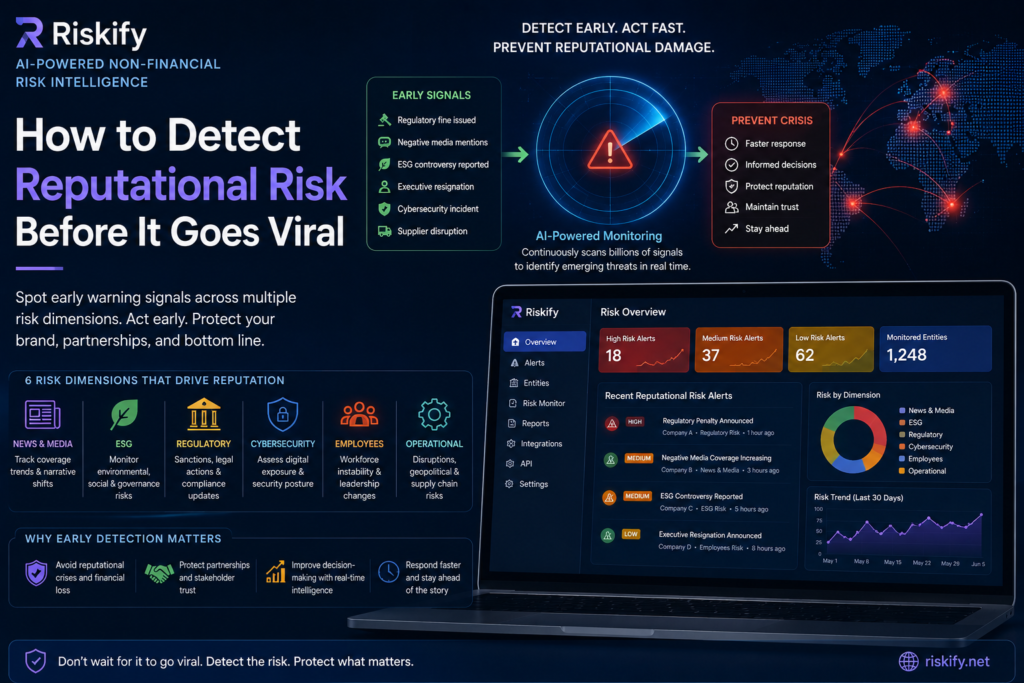
To detect reputational risk before it escalates, organizations must monitor the full spectrum of non-financial signals that precede and shape negative coverage. Riskify structures its risk intelligence across six core dimensions, each of which feeds directly into reputational exposure:
1. News & Media This dimension tracks reputation-shaping events, coverage trends, and narrative shifts around any entity. It is the most direct indicator of reputational risk. A sudden spike in negative coverage often signals that underlying issues have just entered the public domain.
2. ESG (Environmental, Social, and Governance) ESG controversies environmental violations, labor rights concerns, or governance failures are among the fastest-growing drivers of reputational damage. As stakeholder expectations around corporate responsibility rise, ESG signals have become critical early-warning indicators.
3. Regulatory Sanctions, lawsuits, regulatory penalties, and restricted-party listings are among the most concrete and verifiable risk signals available. A regulatory action against a company or its executives often precedes broader negative media coverage by days or weeks making it a valuable leading indicator.
4. Cybersecurity A data breach is one of the most reliably damaging events for a company’s reputation, particularly where customer data is involved. Monitoring an entity’s digital exposure and security posture provides advance visibility into potential breach scenarios before they become headlines.
5. Employees & Workforce Leadership changes, workforce instability, internal conflicts, and talent exodus often signal deeper organizational problems. These signals frequently surface ahead of public reporting, giving risk-aware organizations an early opportunity to reassess their exposure.
6. Operational Disruptions triggered by disasters, geopolitical events, or macroeconomic pressures can rapidly translate into reputational crises especially when companies are slow to respond. Monitoring operational signals helps anticipate these scenarios before they compound.
Why Dimensions Must Be Read Together
Understanding how these six dimensions interact is essential. In most cases, reputational crises do not erupt from a single dimension. Rather, they result from the convergence of multiple signals a pattern that siloed, single-source monitoring almost never catches in time. The supplier scenario described earlier is a textbook example: the crisis was simultaneously a regulatory signal, an ESG signal, and an employee signal before it ever became a media story.
How AI Transforms Early Reputational Risk Detection
The volume and velocity of global risk data makes manual monitoring structurally inadequate. Thousands of news articles, regulatory filings, sanctions updates, and workforce signals emerge every day across dozens of languages and jurisdictions. No human team can process this meaningfully at scale.
This is precisely where AI-powered intelligence changes the equation.
Riskify’s AI engine continuously ingests signals from proprietary datasets, professional data providers, and trusted public records. Rather than simply flagging mentions, it normalizes, classifies, and contextualizes each signal assigning it to the relevant risk dimension, attaching severity indicators, timestamps, and geographic context, then delivering it in structured form through a RESTful API.
What This Enables in Practice
Speed. Risk signals surface in real time, not in daily or weekly reporting cycles. When a regulatory penalty is issued against a counterparty, risk teams receive structured intelligence immediately not the following morning.
Coverage. Aggregating data across proprietary, professional, and public sources provides breadth and depth that no single-source monitoring tool can replicate. This matters most when reputational risks originate in less prominent channels before migrating to mainstream media.
Explainability. Each signal is source-linked and contextualized, so risk teams understand not just what the signal is, but why it matters. This is critical for translating intelligence into decisions rather than noise.
Scale. Whether monitoring a single high-value partner or an entire portfolio of counterparties, the platform scales from single-entity enrichment to enterprise-wide continuous monitoring without a proportional increase in manual effort.
Practical Steps to Detect Reputational Risk Early
With the right intelligence framework in place, organizations can build a structured process for early reputational risk detection. Here is how leading risk teams approach this:
Step 1: Expand your monitoring perimeter. Identify every entity whose reputational failure could affect your organization — not just your own brand, but suppliers, vendors, distribution partners, key clients, and investees. Reputational contagion spreads fastest through business relationships that stakeholders can easily identify and publicize.
Step 2: Monitor across all six risk dimensions simultaneously. Reputational crises almost always have precursors in regulatory, ESG, or workforce data. Limiting monitoring to media coverage alone means watching the last stage of the escalation cycle rather than the first.
Step 3: Set intelligent alerting thresholds. Not every risk signal demands immediate escalation. However, certain combinations a spike in negative media coverage coinciding with a new regulatory action, for instance warrant immediate attention. Threshold-based alerts that account for signal combinations across dimensions significantly improve a team’s ability to prioritize.
Step 4: Integrate risk intelligence into existing workflows. Reputational risk intelligence is most valuable when it flows directly into compliance platforms, due diligence workflows, GRC dashboards, and procurement systems. An API-first architecture makes this integration seamless, enriching existing tools without requiring manual data transfer.
Step 5: Act on early signals, not confirmed crises. The most important behavioral shift in proactive risk management is the willingness to act on early, ambiguous signals rather than waiting for certainty. If a supplier begins generating negative ESG signals and unusual workforce instability simultaneously, the right response is not to wait for a news story. It is to initiate an enhanced review immediately.
Risk, compliance, and procurement professionals who have adopted this approach consistently report that automated intelligence dramatically shortens due diligence cycles replacing days of manual research with an immediate, structured risk overview that strengthens decision confidence from the first conversation. Riskify holds a 4.9 out of 5.0 rating on G2, with users specifically citing the speed and depth of its real-time monitoring as the defining value.
The Competitive Cost of Ignoring Early Signals
To fully appreciate the value of early detection, consider what happens when organizations do not invest in it.
Companies that discover reputational risks reactively after negative coverage has already gained traction face a harder communications and recovery challenge. Stakeholder trust, once shaken by a public crisis, takes considerable time and resources to rebuild. Regulatory scrutiny intensifies following public incidents. Customer attrition can be swift and lasting, particularly in industries where trust is a primary purchase driver.
Beyond the direct financial impact, there is the opportunity cost. Risk teams consumed by crisis response are unavailable for the proactive work that prevents the next crisis. Organizations without real-time risk intelligence tend to cycle between reactive firefighting rather than building the forward-looking capabilities that create durable competitive advantage.
The difference between these two postures is not merely operational. It is strategic. Companies that invest in early reputational risk detection protect not just their brand they protect their ability to grow partnerships, retain clients, and maintain investor confidence through volatility.
Building a Proactive Reputational Risk Program
A modern reputational risk program requires three things: the right technology stack, integration into existing decision workflows, and a team culture that acts on early signals rather than confirmed crises.
On the technology side, the foundation is an intelligence layer that monitors all six risk dimensions continuously, aggregates data from multiple source types, and delivers structured output that risk teams can act on without manual interpretation. Riskify provides exactly this an AI-powered non-financial risk intelligence API that integrates directly into compliance, due diligence, and monitoring workflows. Rather than replacing existing financial risk systems, it complements them by adding the non-financial dimensions increasingly responsible for the most damaging and least anticipated reputational crises.
On the process side, the key shift is treating reputational risk monitoring as a continuous activity not a periodic one. Counterparty screening at onboarding is valuable, but it is insufficient on its own. The supplier whose profile looked clean in January can look very different by March. Continuous monitoring closes that gap.
Finally, on the culture side, proactive reputational risk management requires decision-makers who are empowered to act on ambiguous early signals. The organizations that respond fastest and most effectively to emerging threats are those that have built clear escalation paths for early-stage risk intelligence so that a regulatory flag in a tier-2 supplier never has to become a viral headline first.
Conclusion
Reputational risk in the modern business environment is not a communications problem. It is fundamentally an intelligence problem. Organizations that detect threatening signals early across regulatory, ESG, cybersecurity, workforce, and media dimensions can respond thoughtfully, protect their stakeholder relationships, and avoid the costly cycle of reactive crisis management.
The technology to do this at scale now exists. The question is no longer whether to build proactive reputational risk detection capabilities it is how quickly you can implement them before the next threat surfaces.
Because in reputation management, as in most things, the earlier you see what is coming, the more options you have for what to do next.
Riskify is an AI-powered non-financial risk intelligence API that delivers real-time company risk insights across ESG, regulatory, cybersecurity, operational, employee, and news & media dimensions. Learn more at riskify.net.
Visit our website at https://huntmecoupons.com/store/riskify/ find more amazing deals and promotions.
