
Negative news moves fast. A regulatory penalty announced on a Tuesday morning can trigger a client’s withdrawal by Wednesday afternoon. A supplier embroiled in an ESG controversy can put your own compliance posture at risk before your team even opens their inbox. In today’s business environment, waiting to find out about damaging developments through a news alert, a client complaint, or worse a regulatory inquiry is not a viable strategy. Businesses that want to protect their operations, their partnerships, and their reputations need a way to monitor negative news about companies automatically, continuously, and intelligently.
This guide walks through why manual news monitoring fails at scale, what an effective automated monitoring system actually looks like, and how platforms like Riskify make it possible to track reputational and non-financial risk signals across the companies that matter most to your business.
Why Manual News Monitoring No Longer Works
For years, businesses relied on a combination of Google Alerts, periodic analyst reports, and the occasional news search to keep tabs on their vendors, partners, and counterparties. While these approaches were never perfect, they were at least manageable when business ecosystems were smaller and news cycles moved more slowly.
Today, however, those conditions no longer exist. A mid-sized enterprise may manage hundreds of vendor relationships simultaneously. A compliance team may need to track dozens of geographies, industries, and regulatory regimes at once. A procurement manager evaluating a new supplier faces a universe of public records, news sources, sanctions lists, and ESG disclosures that no human team can process manually at the speed required.
Moreover, manual monitoring creates dangerous gaps. A Google Alert only surfaces stories that match a narrow keyword query. It misses contextual signals a shift in a company’s media narrative, a pattern of workforce instability, a newly imposed regulatory penalty in a jurisdiction your team wasn’t watching. By the time a damaging story reaches your radar through informal channels, the damage may already be done.
Consequently, automated news monitoring is not simply a convenience upgrade. It is, increasingly, a risk management imperative.
What “Negative News” Actually Means in a Business Context
Before exploring how to monitor negative news automatically, it helps to define exactly what kinds of signals matter. In a business risk context, negative news is far broader than damaging headlines. It encompasses any signal across multiple dimensions that could affect a company’s reliability, compliance standing, or strategic value as a partner, vendor, or investment.
Specifically, negative news in a business risk context includes:
Reputational signals such as media coverage of executive misconduct, product failures, customer complaints, or brand controversies that shift public perception of a company.
Regulatory signals including sanctions, legal actions, regulatory penalties, and appearances on restricted-party lists. These signals carry direct legal and compliance implications for any business that maintains a relationship with the affected entity.
ESG signals covering environmental violations, labor practice controversies, governance failures, and sustainability certification lapses. As ESG scrutiny intensifies across global markets, these signals increasingly affect business relationships and procurement decisions.
Cybersecurity signals such as data breach disclosures, changes in a company’s digital exposure, or lapses in security certifications. Given the interconnected nature of modern supply chains, a vendor’s cybersecurity posture directly affects your own risk exposure.
Operational signals related to disruptions caused by natural disasters, geopolitical instability, financial distress, or macro-level events that affect an entity’s ability to deliver on its commitments.
Workforce and leadership signals including executive departures, patterns of employee instability, or significant shifts in organizational structure that may indicate deeper problems within a company.
Understanding this full spectrum is critical, because a monitoring system that only tracks headline news will miss the majority of meaningful risk signals. Effective negative news monitoring covers all of these dimensions not just the ones that make the front page.
The Anatomy of an Effective Automated Monitoring System
So, what does a genuinely effective automated news monitoring system look like? Several core capabilities separate robust platforms from basic alert tools.
Continuous, Real-Time Ingestion
Effective monitoring never stops. Rather than checking for news on a daily or weekly schedule, a capable system continuously ingests signals from multiple sources updating risk profiles as new information emerges. This real-time processing is what allows businesses to detect emerging risks while there is still time to act.
Multi-Source Data Aggregation
No single data source captures the full picture. A strong monitoring system draws from proprietary datasets, professional third-party providers, and trusted public records simultaneously including news outlets, official regulatory filings, sanctions lists, and corporate disclosures. By aggregating across these layers, the system covers signals that any individual source would miss.
AI-Powered Classification and Contextualization
Raw data is not intelligence. A monitoring system must do more than surface mentions of a company name. It needs to classify each signal — determining which risk dimension it belongs to and contextualize it by adding severity, timestamps, geographic context, and source attribution. This transformation from raw signal to structured insight is where AI makes the critical difference.
Explainability and Source Traceability
For compliance and due diligence purposes, knowing that a risk signal exists is only half the value. Teams also need to understand why it was flagged, what source it came from, and how severe it is. Monitoring systems that provide source-linked, explainable outputs allow risk teams to act with confidence and maintain clear audit trails.
Seamless Integration into Existing Workflows
Monitoring alerts are only useful when they reach the right people through the right systems. The most effective platforms deliver intelligence through APIs that connect directly into the compliance tools, GRC platforms, and business intelligence dashboards where decisions are already made rather than forcing teams to check yet another separate portal.
How Riskify Automates Negative News Monitoring
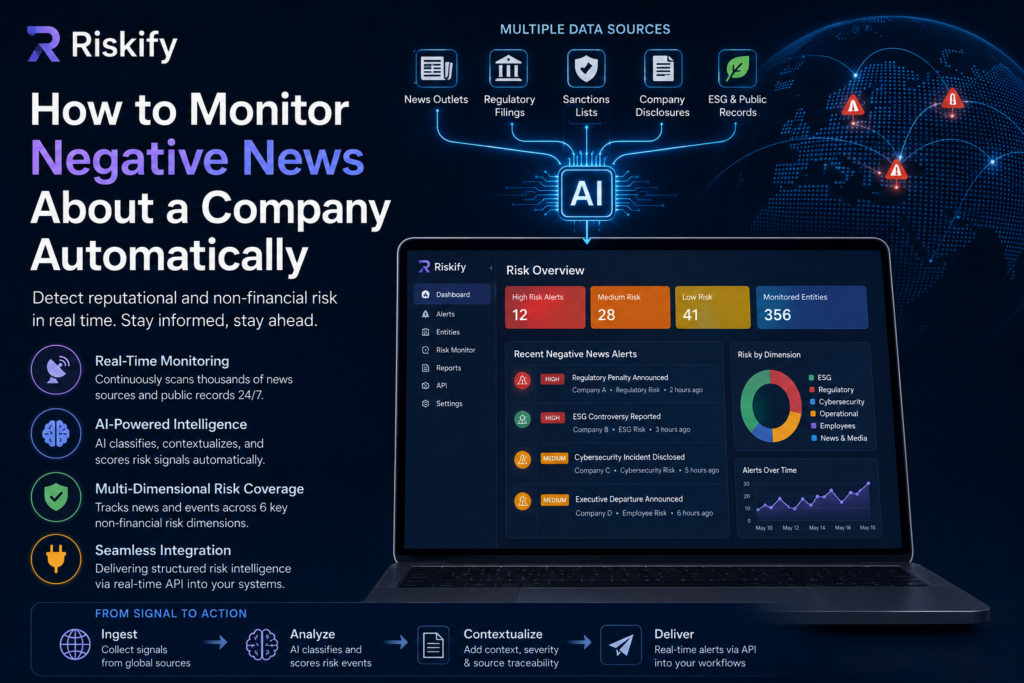
Riskify is an AI-powered non-financial risk intelligence platform that automates exactly the kind of continuous, multi-dimensional company monitoring described above. Rather than requiring manual searches or relying on simple keyword alerts, Riskify’s AI engine continuously collects, classifies, and contextualizes risk signals across all six non-financial risk dimensions and delivers that intelligence in real time through a RESTful API.
The Data Foundation
Riskify’s monitoring capability begins with its data foundation, which brings together three distinct layers. First, it draws on proprietary datasets curated and maintained specifically for non-financial risk assessment, focused on company entities, relationships, and risk attributes. Second, it incorporates professional third-party providers that supply specialized regulatory, ESG, and sector-specific information to enhance coverage and accuracy. Third, it continuously monitors trusted public sources including news outlets, official websites, sanctions lists, and regulatory disclosures normalizing and standardizing that data for consistent analysis.
This three-layer approach ensures breadth, depth, and reliability. Because no single source covers all risk types across all geographies, Riskify’s multi-source architecture significantly reduces blind spots.
The AI Intelligence Engine
Once data enters Riskify’s system, its AI intelligence engine transforms it through a five-stage pipeline. The engine first ingests signals continuously from all data sources across geographies. It then normalizes and standardizes records into unified entity profiles with harmonized formats and attributes. Following normalization, AI models classify each event or attribute into the appropriate non-financial risk dimension. The engine then contextualizes each signal by adding metadata, severity ratings, timestamps, and geographic context making every output explainable. Finally, it delivers structured risk profiles and signals through RESTful APIs for real-time integration into client systems.
This pipeline means that by the time a risk signal reaches a Riskify user, it has already been classified, contextualized, and made actionable. Teams do not need to interpret raw data they receive structured intelligence ready to inform decisions.
The Six Risk Dimensions Riskify Monitors
Riskify structures its negative news and risk monitoring across six core dimensions, each of which captures a distinct category of non-financial risk:
ESG covers standards, certifications, sustainability, and environmental or social controversies tracking when a company’s ESG standing changes or a controversy emerges.
Regulatory encompasses sanctions, legal actions, regulatory penalties, and restricted-party list updates surfacing compliance-critical signals as they occur.
Cybersecurity monitors security certifications, technical posture indicators, and digital exposure signals keeping teams aware of counterparties’ cyber risk profiles.
Operational tracks disruptions driven by disasters, conflict, or macro-level events that could affect a company’s ability to operate or deliver.
Employees captures signals related to workforce stability, leadership changes, and talent movement identifying organizational instability before it becomes a business problem.
News & Media monitors reputation-shaping events, coverage trends, and narrative shifts detecting reputational developments as they emerge in global media.
Together, these six dimensions give businesses a genuinely comprehensive view of negative developments affecting any company they monitor going far beyond what standard news alerts can deliver.
Real-Time API Delivery
Crucially, Riskify delivers all of this intelligence through a real-time RESTful API. This means that instead of logging into a separate dashboard, risk and compliance teams can integrate Riskify’s monitoring feeds directly into their existing GRC platforms, BI systems, compliance workflows, and AI-powered decisioning tools. For development and data teams, this API-first architecture makes it straightforward to embed company news monitoring into any internal system or application.
Riskify is also available through RapidAPI, which further simplifies integration and allows teams to start enriching their workflows in days rather than months.
Practical Applications: Who Benefits from Automated Negative News Monitoring
Understanding the technology is valuable, but the real case for automated monitoring becomes clear when you consider the specific business functions it supports.
Procurement and vendor management teams benefit enormously from continuous monitoring of their supplier base. Rather than conducting periodic reviews, these teams receive real-time alerts when a supplier faces a regulatory penalty, a reputational controversy, or an operational disruption allowing them to take proactive steps before the issue affects their supply chain.
Compliance officers rely on automated monitoring to stay ahead of sanctions updates, legal actions, and ESG violations across their counterparty networks. Manual document-based reviews simply cannot match the speed at which regulatory environments change globally.
Business development and partnerships teams use negative news monitoring during due diligence on prospective partners. Before signing a contract or entering a new business relationship, they can instantly access a comprehensive risk profile covering all six non-financial dimensions rather than relying on a limited web search or a delayed analyst report.
Risk managers incorporate automated monitoring feeds into their broader risk frameworks, adding non-financial dimensions alongside financial risk models to build a more complete picture of entity risk. As verified G2 reviewers have noted, Riskify enables a holistic approach to company risk evaluation one that complements, rather than replaces, traditional financial risk scoring.
Investment teams conducting ongoing monitoring of portfolio companies or acquisition targets use automated news feeds to catch emerging risks early protecting investment decisions with continuous intelligence rather than point-in-time snapshots.
Setting Up Automated News Monitoring: A Practical Framework
If your organization is ready to move from reactive to proactive negative news monitoring, here is a practical framework for getting started.
Define the entities you need to monitor. Start with your most critical counterparties key vendors, strategic partners, major clients, or investment targets. From there, expand to your broader counterparty network as your monitoring infrastructure matures.
Identify the risk dimensions most relevant to your business. Different industries and functions prioritize different risk types. A financial institution may weight regulatory and cybersecurity signals most heavily, while a manufacturer may focus on operational and ESG monitoring. Align your monitoring priorities with your actual risk exposure.
Choose a platform that delivers structured, explainable intelligence. Raw news aggregation is not enough. Look for a platform like Riskify that classifies, contextualizes, and source-links every signal, so your team receives intelligence rather than noise.
Integrate monitoring alerts into your existing workflows. The value of automated monitoring increases significantly when alerts reach the right teams through the systems they already use. Prioritize platforms with robust API delivery that connect into your compliance, procurement, and risk workflows.
Establish a response protocol. Automation surfaces the signals but your team needs a clear process for evaluating and acting on them. Define escalation thresholds, assign responsibility by risk type, and ensure that monitoring feeds into your broader risk governance structure.
Final Thoughts
Negative news about a company rarely announces itself in time for comfortable decision-making. Regulatory penalties, ESG controversies, cybersecurity incidents, and reputational crises move quickly and the businesses that respond fastest are the ones with the best intelligence infrastructure in place.
Automated negative news monitoring solves the core problem that manual approaches have always struggled with: scale, speed, and completeness. By continuously ingesting signals across multiple dimensions, classifying them with AI, and delivering structured intelligence through real-time APIs, platforms like Riskify give risk, compliance, procurement, and business development teams the situational awareness they need to make confident decisions before problems become crises.
For any business serious about protecting its operations and its relationships, automated monitoring is no longer optional. It is, simply, how modern risk management works.
Explore Riskify’s AI-powered non-financial risk intelligence API at riskify.net or get started through RapidAPI.
Discover newest updates and discounts at https://huntmecoupons.com/store/riskify/.
